China – the New Hegemon in Technology and International Trade – not so benign after all.
archive


China – the New Hegemon in Technology and International Trade – not so benign after all.
China exerts significant dominance over the global supply chain of rare earth elements (REEs), spanning reserves, mining, processing, and manufacturing. This control stems from state-supported investments, low-cost production, and export policies, making it indispensable for technologies like electric vehicles, wind turbines, semiconductors, and defense systems. On April 4, 2025, China imposed export license requirements on seven medium and heavy REEs and their derivatives (e.g., metals, oxides, alloys, compounds, targets, and permanent magnets) via Ministry of Commerce (MOFCOM) Announcement No. 18. These controls aim to protect national security and comply with non-proliferation rules but are not outright bans (Jackson, L., Lv, A., Onstad, E., & Scheyder, E2025). On October 9, 2025, MOFCOM Announcement No. 57 expanded controls to five additional REEs (effective November 8, 2025) and immediately restricted rare earth mining and extraction technologies. This would have covered 12 of the 17 total REEs (MOFCOM, 2025). On November 1, 2025, Beijing confirmed the one-year suspension of the October measures following a US-China summit, thereby preventing their enforcement after November 8. The EU has welcomed this as a means of stabilizing supply chains for AI and green technology (Xinhua, 2025).
The U.S. and other countries have invested in domestic production and alternative sources to reduce dependence. The paper situates these developments within the broader context of U.S.-China rivalry, emphasizing the weaponization of REEs as a tool of economic statecraft and national security strategy.
Economic and geopolitical consequences of REEs export limitations by China
It is imperative to understand the paramount importance of the REEs trade limitations for the world economy (with Global North and Global South being impacted differently) and, therefore, also individual consumers. The immediate economic impacts of China's export controls are stark. Supply chain disruptions extend beyond immediate shortages. The extraterritorial provisions complicate multinational operations by requiring licenses for recycling or manufacturing abroad when Chinese technology is involved, thereby increasing compliance costs and regulatory uncertainty (Huld, A, 2025).
Critical industries such as semiconductors, aerospace, and renewables are particularly vulnerable, as REEs like neodymium and dysprosium are irreplaceable in magnets for chips, radar, and batteries. (Underwood, J, 2025). This has slowed production timelines, raised manufacturing expenses, and passed higher costs to consumers, potentially hindering the global energy transition. In the U.S., businesses in EVs and clean energy face heightened pressures, exacerbating trade-war dynamics through retaliatory tariffs (Carr, E, 2025). Historically, similar 2010 restrictions led to a 450% surge in Chinese production dominance but triggered price hikes and global shortages, prompting a WTO dispute that the U.S., Japan, and the EU won in 2014 (Alfaro, L, 2025).
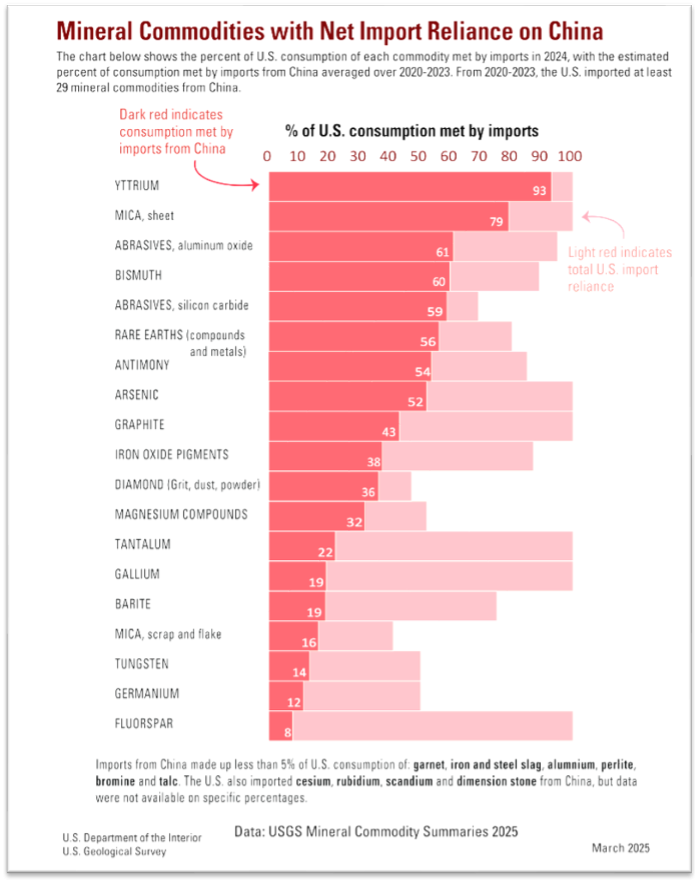
Export restrictions pose critical risks to the global high-tech and defense sectors. REEs are essential for permanent magnets in electric vehicles and wind turbines, phosphors in displays, and precision components in military systems (Tukker, A). The defense sector faces particular vulnerability, as disruptions could compromise weapon systems and military supply chains that depend on specialized heavy REEs, such as dysprosium, for which substitution remains costly and time-intensive1. This dependency has transformed REE access from an economic concern into a national security imperative for technology-dependent nations.
China's export policies have triggered significant diplomatic incidents and formal trade disputes. The 2010 crisis, when China reportedly suspended shipments to Japan during a territorial dispute while simultaneously cutting export quotas, dramatically raised prices and exposed strategic vulnerabilities. Subsequently, the United States, European Union, and Japan challenged Chinese export restraints at the World Trade Organization, with rulings in 2014 finding China's measures inconsistent with WTO obligations. (Giacalone, J. A., & Greenidge, G, 2013). These episodes demonstrated how resource controls can function as instruments of economic statecraft. However, research suggests that such coercion-imposed costs on China by disrupting markets and accelerating diversification efforts by affected states (Kalantzakos, S, 2017).
Dependent nations have pursued multifaceted strategies to reduce reliance on Chinese REE supplies. Japan invested in alternative sources and recycling partnerships following the 2010 disruptions. (Vekasi, K, 2019).The United States restarted domestic processing projects and established strategic stockpiles (Kefferputz, R, 2010). The European Union developed comprehensive raw materials strategies emphasizing upstream diversification (Bilsborough, S, 2012), whereas Australia and other producers expanded exploration and processing capacity to serve global markets outside China2. These responses include recycling initiatives, substitution research, and legal challenges through multilateral institutions (Morrison, W. M., & Tang, R, 2012).
The economic significance of REE dependence is substantial, with global products containing REEs valued at approximately USD 1.5 - 2 trillion (Mancheri, N. A, 2016). Recent research through 2024 reveals that geopolitical relations continue to reshape REE trade patterns, with states pursuing decoupling or hedging strategies as the strategic balance remains dynamic3. Despite WTO rulings and international pressure prompting some Chinese policy adjustments, environmental consolidation and export management measures continue to reshape supply dynamics, sustaining diversification imperatives and strategic planning efforts worldwide (Goreczky, P, 2025).
Weaponization of REEs
Some experts (especially those working in the western hemisphere) hold that, for years now, Chinese decisions on REEs have been a to the weaponization of rare earth minerals (Miiller, A, 2019). Accordingly, “China has a contingency plan to undermine the United States military by cutting off the natural resources critical to America’s defense”.
Back in 2018, apparently, the Pentagon Accused China of Dumping Products to undermine U.S. Security (Seligman, L, 2018). According to a Report by the Office of the Under Secretary of Defense for Acquisition and Sustainment and the Office of the Deputy Assistant Secretary of Defense for Industrial Policy to President Trump (published in September 2018), China and its policies are to be perceived as a significant and growing risk to the United States' manufacturing and defense industrial base (Interagency Task Force, 2018). The authors of the report characterize China as a strategic competitor that engages in economic aggression, undermining U.S. industrial capabilities and national security.
Ultimately, China has evolved from a peripheral economy which harboured offshored capital and production to a major economic power that holds the keys to control the global trade and economic development of the rest of the world. Importantly, Chinese policymakers understand the benefits of such a position and do not hesitate to leverage its political and security interests against other major economies such as the US or the EU. Consequently, the future of the international system is likely to be much more fragmented and multipolar rather than globalised, which also brings with itself volatility risks.
- The time-varying impact of geopolitical relations on rare earth trade networks: What is the role of China's rare earth export restrictions? Technological Forecasting and Social Change. https://doi.org/10.1016/j.techfore.2024.123550
- The geoeconomics of critical rare earth minerals. Journal of Indo-Pacific Affairs.
https://muse.jhu.edu/pub/1/article/805855/summary
- Chinese Rare Earth Exports and US Military Industry: Do Governance Mechanisms De-escalate Strategic Rivalry? https://doi.org/10.1007/s41111-025-00302-5
Jackson, L., Lv, A., Onstad, E., & Scheyder, E. (2025, April 5). China hits back at US tariffs with export controls on key rare earths. Reuters. https://www.reuters.com/world/china-hits-back-us-tariffs-with-rare-earth-export-controls-2025-04-04/
MOFCOM. (2025, October 12). MOFCOM Spokesperson’s Remarks on China’s Recent Economic and Trade Policies and Measures. Ministry of Commerce People’s Republic of China. https://english.mofcom.gov.cn/News/SpokesmansRemarks/art/2025/art_c202dcc0433d476db52b1e7f7fe53926.html
Xinhua. (2025, October 30). China unveils outcomes of China-U.S. economic, trade talks in Kuala Lumpur. The State Council. The People’s Republic of China. https://english.www.gov.cn/news/202510/30/content_WS69032059c6d00ca5f9a072fe.html
Huld, A. (2025, November 10). How Will China’s Rare Earth Export Controls Impact Industries and Businesses? China Briefing. https://www.china-briefing.com/news/chinas-rare-earth-export-controls-impacts-on-businesses/
Underwood, J. (2025, October 10). China’s REE Impact on Global Supply Chains and Industry. Strategic leverage, global disruption, and the Western response. SFA Oxford. https://www.sfa-oxford.com/market-news-and-insights/sfa-china-s-rare-earth-export-controls-and-their-impact-on-global-supply-chains/
Carr, E. (2025, October 17). China’s New Export Controls: Critical Implications For U.S. Businesses. Forbes.https://www.forbes.com/sites/earlcarr/2025/10/17/chinas-new-export-controls-critical-implications-for-us-businesses/
Alfaro, L. (2025, October 28). China’s Rare Earth Restrictions Drive Innovation Abroad. Harvard Business School. https://www.library.hbs.edu/working-knowledge/chinas-rare-earth-restrictions-drive-innovation-abroad
Tukker, A. (2014). Rare earth elements supply restrictions: Market failures, not scarcity, hamper their current use in high-tech applications. Environmental Science & Technology, 48(16), 9973-9974. https://doi.org/10.1021/ES503548F
Giacalone, J. A., & Greenidge, G. (2013). China, The World Trade Organization, And The Market For Rare Earth Minerals. International Business & Economics Research Journal, 12(3), 239-248. https://doi.org/10.19030/IBER.V12I3.7669
Kalantzakos, S. (2017). China and the Geopolitics of Rare Earths. Oxford University Press. https://doi.org/10.1093/oso/9780190670931.001.0001
Vekasi, K. (2019). Politics, markets, and rare commodities: responses to Chinese rare earth policy. Japanese Journal of Political Science, 20(1), 2-20. https://doi.org/10.1017/S1468109918000385
Kefferputz, R. (2010). Unearthing China's Rare Earths Strategy. CEPS Policy Brief No. 218.
Bilsborough, S. (2012). The Strategic Implications of China's Rare Earths Policy. Journal of Strategic Security, 5(3), 1-24. https://doi.org/10.5038/1944-0472.5.3.1
Morrison, W. M., & Tang, R. (2012). China's Rare Earth Industry and Export Regime: Economic and Trade Implications for the United States. Congressional Research Service.
Mancheri, N. A. (2016). An Overview of Chinese Rare Earth Export Restrictions and Implications. In Handbook on the Physics and Chemistry of Rare Earths (Vol. 50, pp. 1-36). https://doi.org/10.1016/B978-0-12-802328-0.00002-4
Goreczky, P. (2025). Weaponizing Rare Earths: China's Strategic Leverage in a Fragmenting Global Order. https://doi.org/10.53300/001c.143302
17 [xxxiv] Miiller, A. (2019, April 18). China Controls, Weaponizes Rare Earth Minerals. The Trumpet. https://www.thetrumpet.com/20546-china-controls-weaponizes-rare-earth-minerals?gad_source=1&gad_campaignid=22981139264&gbraid=0AAAAA9wJyVqjnor6HhMtVVtFHuBlOSxwt&gclid=CjwKCAiA86_JBhAIEiwA4i9JuwhZed9QILaTvuzT8la_CzOR0REck3FeJatdSojazFFRei8DozGSDxoCSMgQAvD_BwE
18 [xxxv] Seligman, L. (2018, October 2). Pentagon Accuses China of Dumping Products to Undermine U.S. Security. Foreign Policy. https://foreignpolicy.com/2018/10/02/pentagon-accuses-china-of-dumping-products-to-undermine-us-security-rare-earth-minerals/
19 [xxxvi] Interagency Task Force. (2018). Assessing and strengthening the manufacturing and defense industrial base and supply chain resiliency of the United States: Report to President Donald J. Trump by the Interagency Task Force in fulfillment of Executive Order 13806. [Publisher]. https://www.whitehouse.gov/presidential-actions/presidential-executive-order-assessing-strengthening-manufacturing-defense-industrial-base-supply-chain-resiliency-united-states/