The International Politics of Womanology
archive


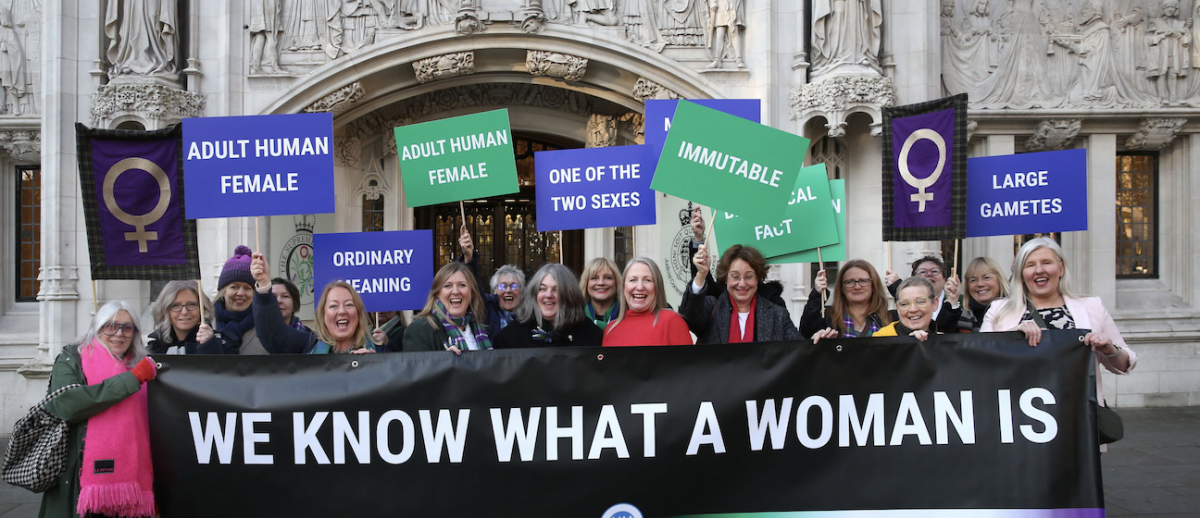
Women protest outside the supreme court in London last November. Photograph: Martin Pope/Zuma Press Wire/Rex/Shutterstock
The International Politics of Womanology
The category “woman” is more capacious and porous than the understandings relied on and promoted by political and legal institutions. Trans women are more visible and better represented in media and public life than ever before. Beyond the Western/Eurocentric/Global North binary framework, there are hijras, travestis and many others living, or managing to live, in “queer” ways that trouble the binary entrapment that makes “man” and “woman” so easily intelligible. That easy intelligibility comes at the cost of confusion for, or punishment of, those who don’t “fit the facts.” Or in other words the categories are the facts for these agencies, whatever anyone says (or shows) to the contrary. In April 2025 the UK Supreme Court hit the international headlines with a remarkable contribution to “womanology” that will be reverberating globally for quite some time. But to appreciate its significance we need to consider how we got to where we are.
The postwar dissensus
The foundation of the United Nations in 1945, and the publication of Simone de Beauvoir’s Le deuxième sexe in 1949, together – and not uncoincidentally – launched the international politics of womanology. Beauvoir’s title alone was enough to set the stage, subversively pointing the finger at the “first sex,” namely men, for defining what sex is and making “woman” number 2.
In one of the most quoted philosophical lines of all time, Beauvoir even more subversively undermined the idea that one is simply born a woman by saying that “one is not” (1949: II, 13). Instead, Beauvoir described womanhood as a “becoming” (1949: II, 13). That declaration contradicted the then-truths of religion and science which straightforwardly claimed that all human beings are born either one sex or the other. Nineteenth-century Darwinian biology completed the picture of homo sapiens as a species, within which individuals are born so as to reproduce it. As sexually reproductive mammals, humans could not, so it was assumed, be an exception.
The religious-scientific consensus that sex is binary, stable and identifiable at birth bifurcates humanity along supposedly “biological” lines. Thus “being” a woman or man arises from a bodily identification made by someone else. Beauvoir’s single line opened the door to a different world where processes of repression and suppression, oppression and exclusion, privilege men and maleness, and also define and subordinate femaleness. Decades of debate about equality in society and sexual difference in human bodies ensued.
The UN’s commitment to women’s rights and equality under Article 1 of the founding Charter made womanology global. The Commission on the Status of Women was set up in 1946, and the Universal Declaration of Human Rights followed in 1948, reiterating women’s equality with men. The stipulation of equal rights for women generated the UN Decade for Women (1976-1985) and a Plan for Action in 1995 (UN n.d.). The whole framework of human rights was and is controversial, only grudgingly acknowledged by some member states, with many of the “second sex” rejecting Beauvoir’s challenge.
Reproducing sex
During the postwar years science and medicine marched into the exact area that Beauvoir identified: “sex,” and how it is “two.” From the 1950s scientists turned their attention to the complexities and contradictions of human sex, identifying, studying and documenting genetic and hormonal “variants” and “syndromes” (Fausto-Sterling 2000). The religious-scientific consensus was broken, and scientists and clinicians battled religious and moral activists, regulatory strictures, legal suppression and political demonization (Repo 2015). “Playing God” was a common and often legally and socially enforced objection (England et al. 2018). Through all the religious-moral-cultural disagreements “biology” was often invoked and sciences cited, physical and social.
Reproductive technologies and associated public/private and more or less regulated service industries then developed apace. The now-familiar in-vitro fertilization (IVF) techniques were introduced in ways that safely stick to the male/female sex binary, insofar as “sex” is the same as human spermatozoa and ova. But IVF troubles the stereotypical and legally enforced notions of mother and father quite profoundly. At present there is the possibility of two egg-mothers, a sperm father, a surrogate mother, and one or two (but not more) adoptive parents (of either sex, however that is determined by birth certificates or other registration). Enter the UK Supreme Court.
Court orders
In a ruling of April 25th, 2025, the UK Supreme Court jumped feet-first into the international politics of womanology (Supreme Court of the United Kingdom 2025), reiterating the very position that Beauvoir famously negated: one is simply “born a woman.” How one “becomes” a woman is then something else.
While the Supreme Court’s jurisdiction in this case extended only to England, Wales and Scotland, the judgment “For Women Scotland Ltd (Appellant) v The Scottish Ministers (Respondent)” already has worldwide implications and consequences. This is because British court judgments have considerable weight within the Anglosphere of law and politics, and because English is the working international language at the UN and throughout the most influential international organizations, as well as the international media. The Supreme Court justices’ argumentation, on their self-defined terms, is “clear” and “consistent,” and the text will be widely read and quoted.
The three lords and two ladies justice of the Supreme Court found unanimously in favour of the appellant’s claim that discrimination against trans women in respect of “women-only spaces” is lawful. Lower UK courts had rejected that claim. Under the “protected category” of sex, the Equality Act of 2010 (EA 2010) allows for discrimination against men on grounds that women, as a group, are particularly vulnerable to male sexual violence and were similarly due privacy and security in circumstances such as public lavatories and changing rooms.
In considering this legislation, the lower courts had taken another Act, the Gender Recognition Act of 2004 (GRA 2004), at its word. Its provisions state that, for example, changing one’s sex “from man to woman” thus changes one’s gender “from male to female …for all purposes.” Hence it followed that discrimination against trans women, with or without a Gender Recognition Certificate (GRC), in respect of women-only spaces, was unlawful.
The Supreme Court need not have considered the appeal, thus leaving previous judgments to stand, or it could have advised Parliament to produce legislation further to the two key Acts: the GRA 2004 and the EA 2010. However, the Court chose to intervene.
In doing so the Court reversed the usual order of legal consideration and re-read the GRA 2004 in light of their own interpretation of the will of Parliament in legislating the EA 2010. Their reasoning emphasized the need for ordinary people, and particularly those administering public services and spaces, to have “clarity” and “consistency” in the law, lest indeterminacy render many activities unworkable or impossible.
While limiting the scope of their vocabulary and reasoning to acts of Parliament, governmental guidance and similar policy documents, rather surprisingly the Court boldly announced that their judgment would stand on two locutions that do not appear elsewhere in the legislation. Those locutions were: “biological sex” and “certificated sex.”
The Court also acknowledged that sex and gender are used indifferently and synonymously to mean the same thing, and that for ordinary people the “plain meaning of words” will underpin the consistency and clarity they were aiming for. Thus two epistemological claims underpin the Court’s ontology of woman as female, and female as woman. Firstly, there is the Court’s reference to biology in “biological sex” – the word “biological” is repeated 192 times in the judgment. While neither “sex” nor “female” is defined in any physiological way, the judgment understands woman/women as vulnerable to rape and male sexual violence, as on average weaker in strength and stamina to men, as capable of pregnancy and maternity, and as persons for whom cervical smear tests are relevant.
Secondly, the Court assigns itself privileged access to what “ordinary language,” as used by ordinary people, means and doesn’t mean. On those terms the Court understands sex as an M/F binary, obvious at birth in some unproblematic way and recorded – rather than assigned – near the time. For the Court that certification is a point of certainty because it is originary. Infants are presumed to be devoid of agency and their bodies are assumed to be nakedly truthful.
From this womanology of sex/gender, where a wholly unreferenced concept of biology merges with ordinary English as an apparently unambiguous repository of meaning, the Court then addressed the protected category of “gender reassignment” within the EA 2010. Trans women, it reasoned, are protected from discrimination as trans, but also protected from discrimination on grounds of sex, since their “acquired gender” is that of woman. However, on the basis of that unexplained, “ordinary-language” understanding of “biological sex,” the Court took the view that trans women are “biological males.” The Court thus decided that discriminating against them in respect of women-only spaces is lawful, as the original appellants had argued.
Legal reasoning and contrary realities
Some readers may recognize the terms of debate here as they arose in the UN World Conference on the Rights of Women held in Beijing in 1995. What rights of protection do states owe to women? What rights of political participation should women have? Since that time debates and conflicts have taken a more theoretical turn with trans-exclusionary and so-called “gender critical” feminisms, arguing – as the UK Supreme Court has done – from “biological” conceptions of human physiology and unexamined “common sense” attributed to ordinary people.
An important consequence of the Court’s womanology is that intersex and non-binary physiologies and identity-claims do not exist, nor does “gender reassignment” in the UK and elsewhere have much purchase. Quite the reverse. Binaries of M/F are invoked to determine biologies, because categories are projected onto realities. Global realities are quite otherwise.
Beauvoir, S. de. 1949. Le deuxième sexe. Paris: Gallimard.
England, M. et al. Eds. Reproductive Geographies. 2018. London: Routledge.
Fausto-Sterling, A. 2000. Sexing the Body. New York: Basic Books.
Repo, J. 2015. The Biopolitics of Gender. New York: Oxford University Press.
Supreme Court of the United Kingdom. 2025. For Women Scotland Ltd (Appellant) v The Scottish Ministers (Respondent)
UN n.d. Global Issues. Gender Equality | United Nations