The Impact of Intergenerational Organizing Histories: Resisting ICE Raids and Mass Deportations on the Central Coast of California
archive

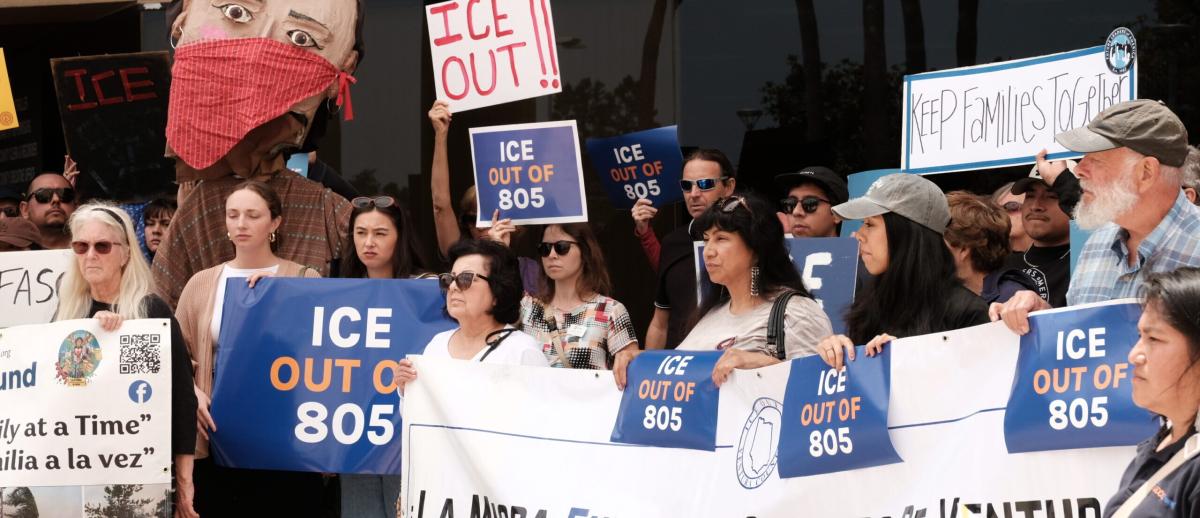
A coalition of farmworkers, advocates, industry growers, nonprofits and California’s ICE raid Rapid Response network spotlight the impacts of escalated workplace raids at a press conference in Santa Maria on Thursday, June 12. (Courtesy: Central Coast Alliance for a United Economy)
The Impact of Intergenerational Organizing Histories: Resisting ICE Raids and Mass Deportations on the Central Coast of California
On July 10, 2025, masked agents from Immigration Customs Enforcement (ICE), Department of Homeland Security (DHS), and the Border Patrol conducted raids in Carpinteria and Camarillo, cities located along California’s Central Coast (Santa Barbara, Ventura, and San Luis Obispo Counties). More than three hundred farm workers were detained and deported. Many families have been impacted, with parents being separated from their children (Hayden 2025). One farm worker, Jaime Alanis García, died after he climbed onto a greenhouse roof and fell in an effort to hide from ICE agents. Alanis was from Huajúmbaro, a small town in Michoacán, Mexico. His niece, Yesenia Duran stated, “My uncle was just an innocent, hard-working farmer. He has his wife and daughter waiting for him” (Anguiano 2025; Bacon 2025). Calling his death “sad” and “unfortunate,” Trump Administration Border Czar Tom Homan stated that Garcia was not in “ICE custody and ICE did not have its hands on this person” (Lewis 2025). Homan’s comment obfuscates what really happened that day—federal agents used chemical weapons and flash bang grenades against community members, mothers, fathers, workers, and even the region’s elected Congressional Representative Salud Carabajal, who is a military veteran who previously served in the U.S. Marines (Cruz 2025a). These officers terrified Garcia, causing his death and sowing fear across the region.
Community members have not backed down, however. The Central Coast Alliance for a Sustainable Economy (CAUSE), the Mixteco Indigena Community Organizing Project (MICOP), 805 UndocuFund, Immigrant Legal Defense Center (ILDC), Carpinteria Immigrant Rights Coalition, Indivisible Santa Barbara, VC Defensa, Unión del Barrio, the Fund for Santa Barbara, and many other organizations are organizing, tracking unmarked ICE vehicles, sending out alerts, providing important support services, including food, clothing, counseling, transportation, and other daily necessities (Cruz 2025b). The Central Coast has a long, rich, intergenerational history of organizing and social movements, dating back more than a century, when Japanese and Mexican beet farm workers formed an interracial union in Oxnard in 1903 (Almaguer 1984; Barajas 2012). The Japanese Mexican Labor Association (JMLA) predated the mostly Filipino and Mexican-led United Farm Workers (UFW), which emerged from the merger of the Agricultural Workers Organizing Committee (AWOC) and the National Farm Workers Association (NFWA) (Griswold del Castillo and García 1995). Before co-founding the NFWA in 1962, Dolores Huerta and others worked extensively with the Community Service Organization (CSO), particularly one of its most influential founders and strategists, Fred Ross Sr. (Thompson 2019).
A CSO chapter was opened in Oxnard in 1958, primarily to support the United Packinghouse Workers of America’s local unionization campaign (Barajas 2012). While that effort failed, the UFW took off in the late 1960s, inspiring Chicana/o students in Ventura and Santa Barbara Counties to form organizations like the United Mexican American Students (UMAS) and Movimiento Estudiantil Chicano de Aztlán (MEChA) at Ventura and Oxnard Community Colleges and the University of California, Santa Barbara (UCSB) (Armbruster Sandoval 2017; Barajas 2021). Chicano garbage workers in Santa Barbara later organized a militant strike that ended in police repression on May 1, 1976 (Olguín and Giardello 2023). That strike occurred in the working-class Chicana/o Eastside neighborhood, home to La Casa de la Raza, a vibrant community-based organization that emerged during the Chicano Movement, advocating for social justice and sponsoring events such as UFW fundraisers and benefit concerts for Central American immigrants in the 1980s.
In the mid-1970s, UCSB Chicana/o students established a new organization, El Congreso. Previously, MEChA and another Chicana/o student group, La Raza Libre, had feuded, generating significant and long-lasting divisions on and off campus, impacting community groups like La Casa de la Raza (Marquez 2007). El Congreso included several sub-committees, most notably for this paper, Centro de Inmigración y Asistencia Pro Comunidad (CINAC), an immigrant rights organization founded by prominent community member Etelvina Menchaca who previously served on as a La Casa de la Raza board member (Noozhawk 2019). UCSB undergraduate students Marcos Vargas and Nancy Weiss were also involved with CINAC, which held its meetings at La Casa de la Raza. Vargas later worked as Executive Director of El Concilio de Condado de Ventura, a leading Latino civil rights organization for eight years (1987-1995), and Weiss was the Executive Director for the Santa Barbara Rape Crisis Center and then the Fund for Santa Barbara, a crucial nonprofit philanthropic organization that provides grants to social justice organizations on the Central Coast. Weiss (2024) later collaborated with Nick Tonkin, who worked with Catholic Charities and was a reporter with the Santa Barbara Independent, as part of the Santa Barbara Coalition Against Proposition 187 in 1994. Proposition 187 was a racially charged ballot measure that would have cut off health and educational services to undocumented immigrants (HoSang Martinez 2010). Santa Barbara Chicana/o high school students who were involved with MEChA chapters on their campuses also worked tirelessly to defeat Proposition 187 (Sanchez 2025). These students were mentored by Raquel Lopez, long-time Santa Barbara resident and Director of the city’s youth programs in the mid-1990s and Benjamin (“Benny”) Torres, La Casa de la Raza youth services director and former El Congreso member and UCSB undergraduate student (Torres was, incidentally, one of three student negotiators during the 1994 Chicanx/Latinx student hunger strike) (Armbruster Sandoval 2017; Lopez 2024; Torres 2025).
In the late 1990s and early 2000s, the Coalition for a Living Wage, which called for a higher livable, rather than minimum, wage for city employees, emerged. The Coalition included UCSB students like Harley Augustino, Service Employees International Union (SEIU) Local President Walt Hamilton, Das Williams (future Santa Barbara County Supervisor and Assembly member), Helene Schneider (future Santa Barbara Mayor), and many others (Zucker 2021). Fueled partially by the iconic Battle in Seattle targeting the World Trade Organization in late 1999, the Coalition for a Living Wage was successful and evolved into a new organization called PUEBLO (People United for Economic Justice through Organizing). PUEBLO helped organize a massive immigrant rights demonstration in Santa Barbara on May 1, 2006, that drew more than 20,000 people who marched down State Street, holding signs that read “We Are Not Criminals.” PUEBLO later merged with CAUSE, which earlier pushed Ventura County to pass a living wage ordinance in 2001. Marcos Vargas founded CAUSE and led the organization for fifteen years until Maricela Morales replaced him. Vargas went on to become Executive Director of the Fund for Santa Barbara in 2015, replacing its longtime leader, Geoff Green, who was UCSB Associated Students President in 1994 and later Grants Manager with the Fund when Nancy Weiss was the Executive Director. Around the same time as the May Day 2006 marches in Santa Barbara and nationwide, UCSB undocumented students formed their organization, IDEAS (Improving Dreams, Equality, Access, and Success). IDEAS members collaborated with community organizations to push for the federal DREAM Act, which failed in a memorable close vote in the U.S. Senate in 2010.
This narrative is not comprehensive, as there have been numerous community members, students, teachers, faculty, workers, mothers, fathers, and immigrants who have courageously struggled for social justice on the Central Coast for well over a century. The recent ICE raids were horrifying, as Jaime Alanis died after heavily armed, masked federal agents raided two cannabis farms and kidnapped and deported hundreds of Latina/o immigrants. As the raids were taking place, a rich, intergenerational movement swung into action, standing before the agents, demanding that they stop enacting state-sanctioned violence on everyday people struggling for a better life. Just four people of the more than three hundred who were arrested had criminal records. What took place was a theatrical spectacle, “smoke and mirrors,” as the local Santa Barbara Independent aptly called it in their special issue after the raids occurred (Cruz 2025a).
Social movement scholars have long debated when movements emerge and end (Dowd Hall 2004). Historians often periodize movements, like the Chicano Movement, for example, as starting when the United Farm Workers began in 1965 and concluding in 1975, when U.S. troops left Vietnam. To cite another example, the Civil Rights Movement began in 1955 when Rosa Parks sat down and launched the Montgomery Bus Boycott and ended in 1965 after the Voting Rights Act was passed (Theoharis 2018). These two movements, however, emerged long before the UFW and Mrs. Parks took decisive action, and they persisted long after the Vietnam War ended and the Voting Rights Act was passed. Chicanx and Latinx people have been fighting for social change in Santa Barbara ever since settler colonialism emerged after the U.S.-Mexico War ended in 1848. Indeed, they fought the Ku Klux Klan in the 1920s, and they resisted mass deportations in the 1930s that led to the removal of more than 2 million Mexicans (60% U.S. citizens) during that time period (Camarillo 1979). In Ventura County, Black and Latinx activists targeted the KKK after it attempted to screen the racist film, Birth of a Nation, in Oxnard in 1978 (Huynh 2024).
The Central Coast region was rocked by ICE’s recent actions, making national and international news. What wasn’t reported was the incredibly deep decades of resistance to racist, white supremacist, sexist, and economically exploitative policies that have had a devastating impact on communities of color, women, immigrants, and working-class folks. The Central Coast isn’t Los Angeles or the Bay Area, regions where resistance is legendary and more well-documented. But here, in Oxnard, Carpinteria, Santa Barbara, Goleta, Ventura, and other cities, people have always fought back, and they will continue even though many are scared and frightened. The state has always relied on violence to quash struggles for dignity and justice, which will persist just as they have across multiple generations.
Almaguer, Tomas. 1984. “Racial Domination and Class Conflict in Capitalist Agriculture: The Oxnard Sugar Beet Workers’ Strike of 1903,” Labor History 25(3): 325-350.
Anguiano, Dani. 2025. “Farm Worker Who Died After California ICE Raid was ‘Hardworking and Innocent,’ Family Says,” The Guardian (July 14). https://www.theguardian.com/us-news/2025/jul/14/jaime-alanis-california-ice-raid-death.
Armbruster Sandoval, Ralph. 2017. Starving for Justice: Hunger Strikes, Spectacular Speech, and the Struggle for Dignity. Tucson: University of Arizona Press.
Bacon, David. 2025. “Why did this Farm Worker Die in an Immigration Raid?” The Nation (July 17). https://www.thenation.com/article/society/ice-raid-jaime-alanis-garcia/.
Barajas, Frank. 2021. Mexican Americans with Moxie: A Transgenerational History of El Movimiento Chicano in Ventura County, California, 1945-1975. Lincoln, NE: University of Nebraska Press.
2012. Curious Unions: Mexican American Workers and Resistance in Oxnard, California, 1898-1961. Lincoln, NE: University of Nebraska Press.
Cruz, Ryan. 2025b. “This is an Emergency,” Santa Barbara Independent (July 17-24). https://www.independent.com/2025/07/16/this-in-an-emergency-emotions-run-high-at-santa-barbara-town-hall/.
Cruz, Ryan. 2025a. “Smoke and Mirrors,” Santa Barbara Independent (July 17-24). https://www.independent.com/2025/07/16/how-it-happened-timeline-of-immigration-raid-in-carpinteria/.
Hall, Jacquelyn Dowd. 2005. “The Long Civil Rights Movement and the Political Uses of the Past,” Journal of American History 91(4): 1233-1263.
Hayden, Tyler. 2025. “ICE Raids Leave Families in the Cold,” Santa Barbara Independent (July 17-24). https://www.independent.com/2025/07/16/ice-raids-leave-families-in-the-cold/.
Hosang Martinez, Daniel. 2010. Racial Propositions: Ballot Initiatives and the Making of Postwar California. Berkeley: UC Press.
Huynh, Jaden. 2024. “Kalifornia Klan Kulture: The Ku Klux Klan’s Usage of Media and Reporting in 1970s Southern California,” The UC Santa Barbara Undergraduate Journal of History 4(2): 1-18.
Lewis, Lauren. 2025. “CNN Host Corners Tom Homan: ‘Do You Have Compassion?’” (July 13).
https://www.thedailybeast.com/cnn-host-corners-trump-border-czar-tom-homan-do-you-have-compassion/.
Lopez, Raquel. 2024. Interview with Author. July 5. Santa Barbara, CA.
Marquez, Yolanda Loza. 2007. La Universidad con del promesa futuro: A Case Study of the University of California, Santa Barbara Department of Chicano Studies, 1965-1980. PhD Dissertation.
Noozhawk. 2019. “Etelvina Menchaca, 1938-2019,” June 2. https://www.noozhawk.com/ etelvina_menchaca_of_santa_barbara_1938_2019/.
Olguín, Ben and Edward Giardello. 2023. “The Forgotten Foundations of Chicana/o/x and Latina/o/x Studies: El Plan de Santa Barbara and Damián García’s Revolutionary Synthesis,” Aztlan 48(2): 213-245.
Sanchez, Dinorah Lilliana. 2025. Interview with Fabian Pavón. July 8. Santa Barbara, CA.
Theoharis, Jeanne. 2018. A More Beautiful and Terrible History: The Uses and Misuses of Civil Rights History. Boston: Beacon Press.
Thompson, Gabriel. 2016. America’s Social Arsonist: Fred Ross and Grassroots Organizing in the Twentieth Century. Berkeley: University of California Press.
Torres, Benjamin. 2025. Interview with Fabian Pavón and author. July 9. Zoom.
Weiss, Nancy. 2024. Interview with Author. July 7. Santa Barbara, CA.
Zucker, Lucas. 2021. “Organizing in Rural Towns and Suburbs: Central Coast United for A Sustainable Economy,” in Igniting Justice and Progressive Power, David Reynolds and Louise Simmons (editors). New York: Routledge.