Tumba este duro¡: Art, Re-presentation, and Solidarity at the U.S.-Mexico Border
archive

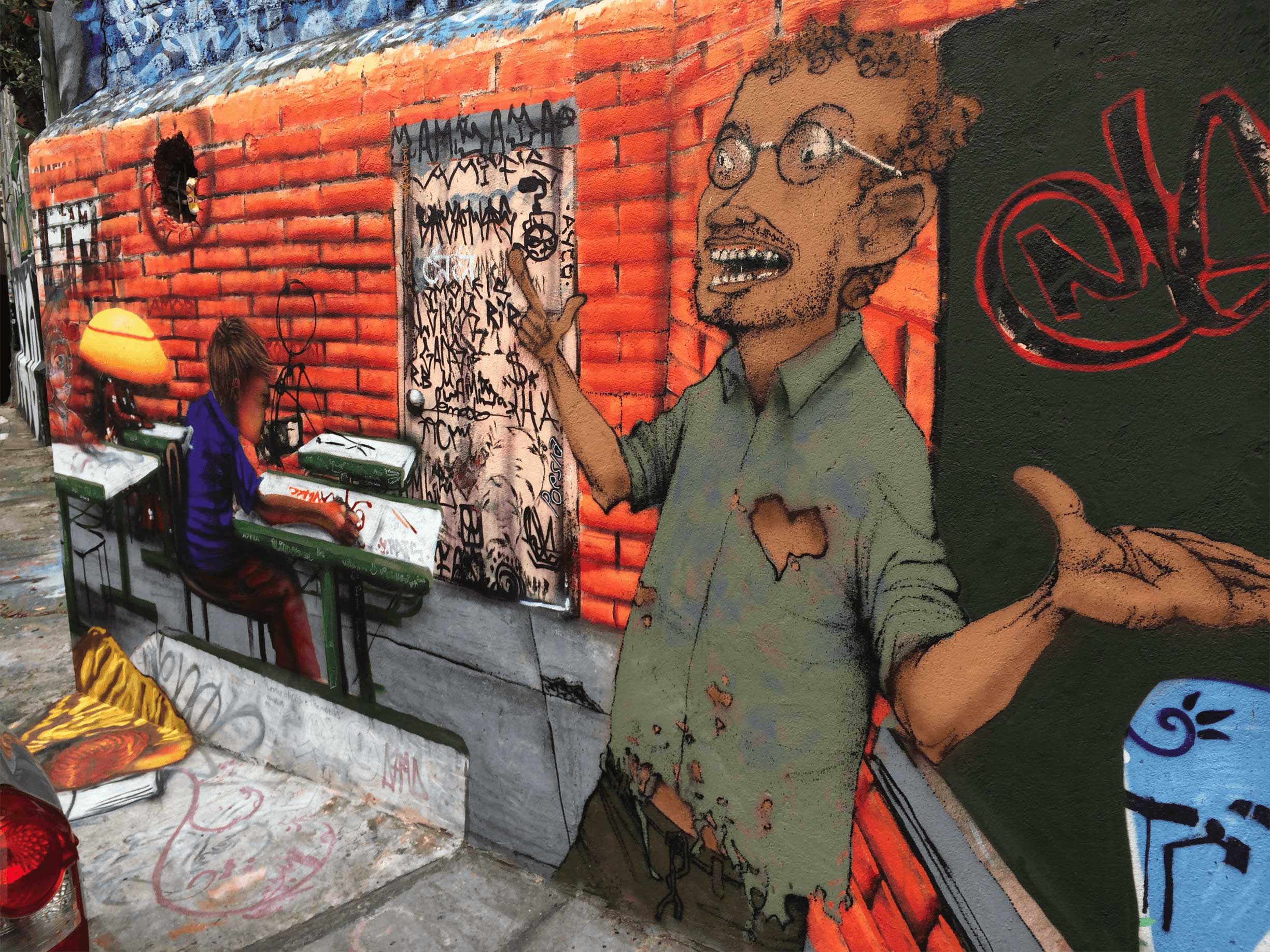
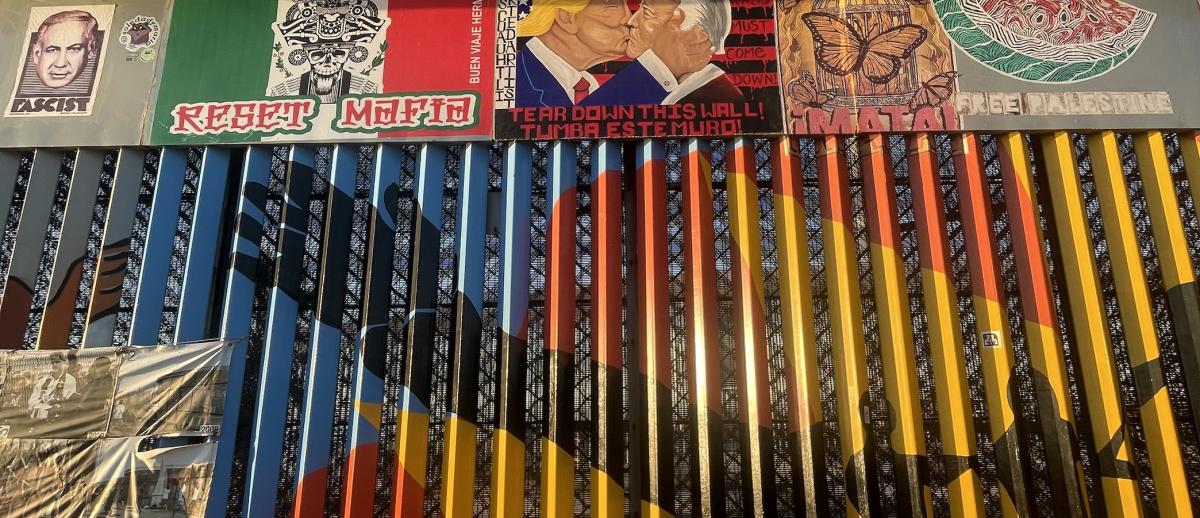
Various artworks on the border wall at Friendship Park in Playas De Tijuana, Mexico in October 2025.
Tumba este duro¡: Art, Re-presentation, and Solidarity at the U.S.-Mexico Border
Border walls are destructive infrastructures used to surveil, dehumanize, and violate urban communities. As physical embodiments of abusive state power and technocapitalist militarism, these walls engender infrastructural violence (Rodgers and O’Neil 2012). Yet just as borders engender the necropolitics (Mbembe 2003) of nation-states, they are also arenas of enduring struggles for justice and sovereignty. Borders, then, are not only infrastructures of violence and sovereign power but potential “sites of new political possibilities” (Brambilla and Jones 2020, 292). In this short essay, I examine how muralists at the U.S.-Mexico border wall appropriate its infrastructure to expose the border’s inherent contradictions, contest racial discourses of immigration, and visualize new political possibilities. Specifically, I analyze how deported artists in Tijuana, Mexico, paint and annotate (Kalir 2025) the wall at Friendship Park, Playas de Tijuana, particularly where the structure bifurcates Tijuana and San Diego, California. The muralists re-present the wall, demonstrating how artistic intervention can undermine infrastructural and discursive violence in walled cities.
Unequal Neighbors: Tijuana and San Diego
Tijuana and San Diego are what Maher and Carruthers (2021) call “unequal neighbors.” For much of their interrelated histories, the latter has framed the former as a racialized Other to be exploited and consumed. Crossings between the two, especially from north (U.S.) to south (Mexico), were largely accommodated and encouraged throughout the first half of the twentieth century. This changed in the 1980s after the Reagan administration passed the Immigration Reform and Control Act in 1986. While the law allowed some undocumented residents in the U.S. to pursue legal status, its ultimate effect was to frame unauthorized immigration as a threat to U.S. national security. In 1994, the Clinton administration advanced this policy. He launched Operation Gatekeeper, an anti-immigrant program of deterrence, which inaugurated the carceral border landscapes we are familiar with today. Gatekeeper prescribed the erection of a 14-mile fence at the U.S.-Mexico border between Tijuana and San Diego. The barrier split bi-national social spaces like Friendship Park, a cultural landmark and gathering place established in the early 1970s for transborder residents and communities. The wall separated migrant families, disrupted cross-border cultural practices, and destroyed natural ecosystems on both sides. That same year, Clinton brokered the North American Free Trade Agreement (NAFTA), which opened Mexico to free trade and a global capitalist marketplace. NAFTA compelled the proliferation of maquiladoras, or Mexican factories where low-wage workers (predominantly women) assemble duty-free products for export. Incentivized by access to inexpensive labor, some multinational companies exploited a production model known as the “Twin Plants,” establishing manufacturing operations in Tijuana with corresponding parent offices in San Diego.
While the U.S. liberalized trade relations with Mexico to serve corporate interests, it simultaneously employed punitive border enforcement that criminalized Mexican communities in Tijuana. This intensified following the attacks on September 11. Over the next two decades, the border wall was systematically fortified, heightened, and extended. In 2009, the Obama administration closed the U.S. section of Friendship Park (Beaubian 2009), installing a second fence reinforced with surveillance cameras, barbed wire, and sensors to thwart movement between Tijuana and San Diego. Friends and loved ones living on opposite sides of the border were no longer able to see each other or practice connection across the divide. Most recently, in August 2023, the Customs and Border Protection (CBP), under the Biden administration, replaced an 18-foot section of the structure with a 30-foot wall, eliminating views into the U.S. side of Friendship Park. The community artworks on the previous wall, which memorialized deceased loved ones, deported U.S. veterans, and deported childhood arrivals (—were torn down in the construction project. While a Tijuana-based nonprofit organization preserved the older artworks, new murals and commemorative acts materialized on the 30-foot wall to protest the enclosure.
Re-Presenting the Wall
In March 2023, artists Javier Salazar Rojas (known as Deported Artist) and Chris Cuauhtli painted a mural on the border wall at Friendship Park in Playas de Tijuana. The artwork depicted U.S. Presidents Donald Trump and Joe Biden sharing a kiss. At the top, the artists painted a phrase in black, capitalized lettering (“DIOS MÍO AYUDAME A SOBREVIVIR”) and culminated the sentence below the American figureheads’ silhouette in red (“ESTE AMOR MORTAL”). Rojas and Cuauhtli provided the English translation at the edge of the piece: “MY GOD HELP ME TO SURVIVE THIS DEADLY LOVE.”
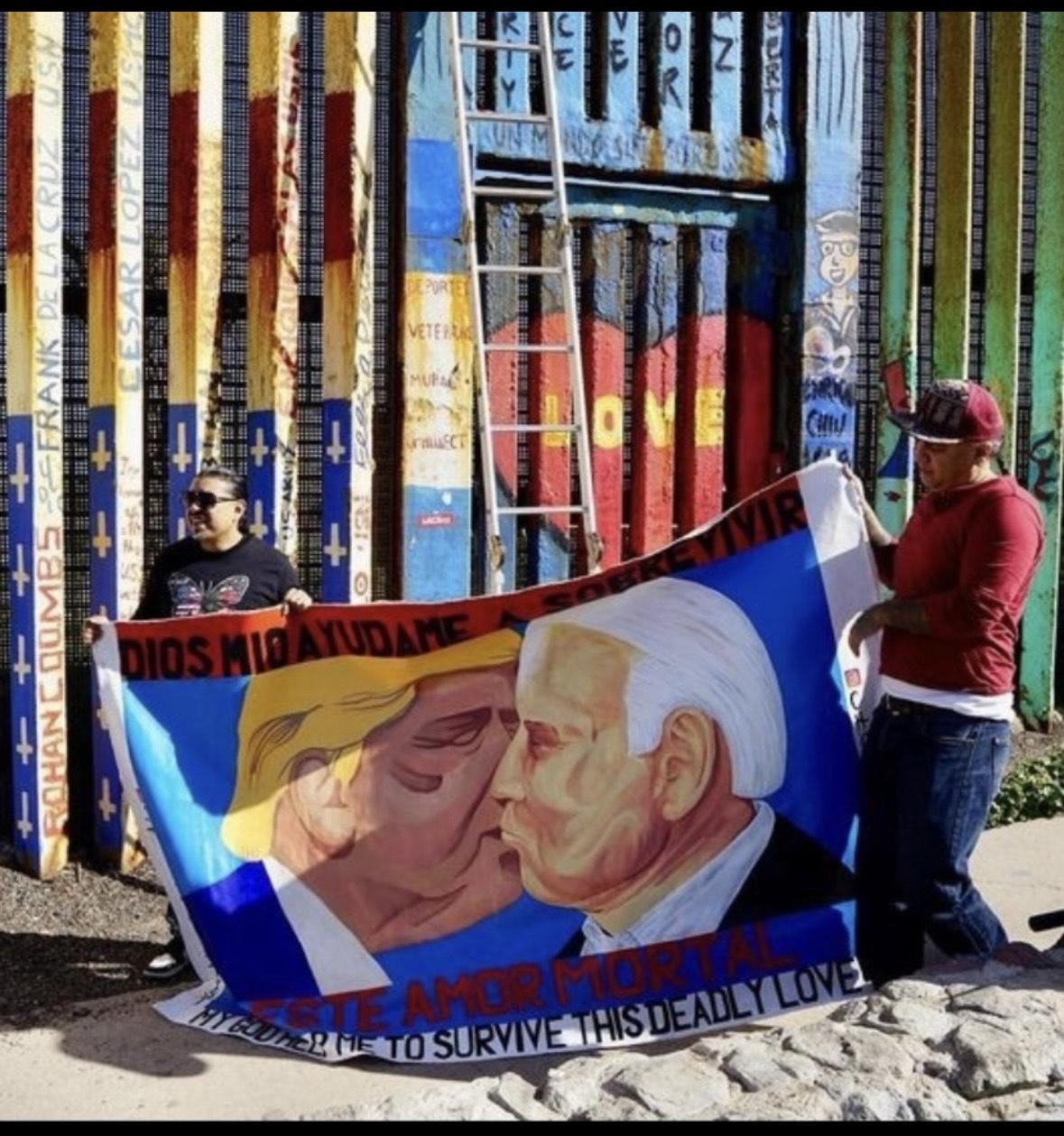
Artists Javier Salazar Rojas (left) and Chris Cuauhtli (right) hold their mural portraying a symbolic kiss between U.S. Presidents Donald Trump and Joe Biden at the border wall in Friendship Park, Tijuana, Mexico in March 2023. (Photo credit: JAVIER SALAZAR ROJAS / @DeportedArtist)
The mural, El Beso Mortal (The Deadly Kiss), remixed Dmitri Vrubel’s iconic 1979 graffiti art on the notorious Berlin Wall and used its seminal phrase (“Mein Gott, hilf mir diese tödliche Liebe zu überleben / “My God, help me survive this deadly love”) to indict the United States’ bipartisan investment in the brutal militarization and policing of the border. The “deadly love” in this context referred to the Trump and Biden administrations’ shared culpability for rampant civilian death and familial suffering at the U.S.-Mexico border. By re-presenting the wall, and its attendant racist rhetoric, as a deadly love affair transcending party lines, Rojas and Cuauhtli positioned the U.S. nation-state as the true purveyor of violence and instability in the transborder region. The mural reinterpreted border militarization and enforcement as lethal operations to annihilate migrant communities, exposing the wall as a catalyst to terror rather than a defense against it.
The mural’s critique of state-sponsored terrorism and infrastructural violence was not restricted to the wall between Tijuana and San Diego. In an interview, Rojas shared that their 2023 painting was inspired by political art on another wall: the illegal West Bank Barrier in Occupied Palestine. The deported artists drew inspiration from a mural painted on the Apartheid wall in Bethlehem by Australian graffiti artist Lush Sux in 2017.
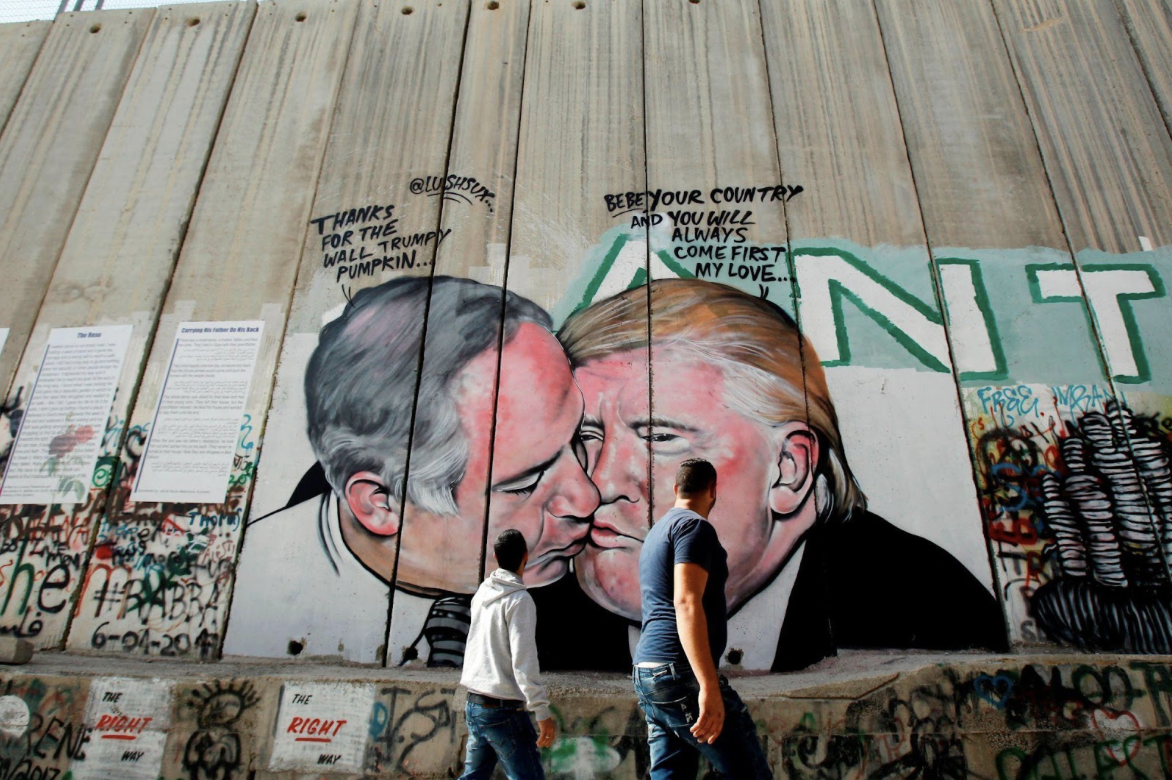
Palestinian men walk past a graffiti by street artist Lushsux, depicting US President Donald Trump kissing Israeli Prime Minister Benjamin Netanyahu drawn on the controversial Israeli separation barrier separating the West Bank town of Bethlehem from Jerusalem, on October 29, 2017. (Photo credit: MUSA AL SHAER/AFP via Getty Images)
Lush Sux’s 2017 piece showcased a fictive kiss and dialogue between a newly-elected Trump and Israeli Prime Minister Benjamin Netanyahu. While smooching, Netanyahu remarked, “Thanks for the wall Trumpy pumpkin….” Trump responded, “Bebe your country and you will always come first my love….” The artwork, though criticized by some Palestinian activists and artists for its contribution to ‘occupation and wall tourism’ (Ashly 2017), attempted to denounce the U.S. government’s unwavering support for Israel’s occupation of historic Palestine and condemn the leaders’ shared affinities for settler-colonial partitions. Rojas and Cuauhtli incorporated this visual referent into their 2023 mural, forwarding an implicit critique of imperialist power at the U.S.-Mexico border and in the SWANA region.
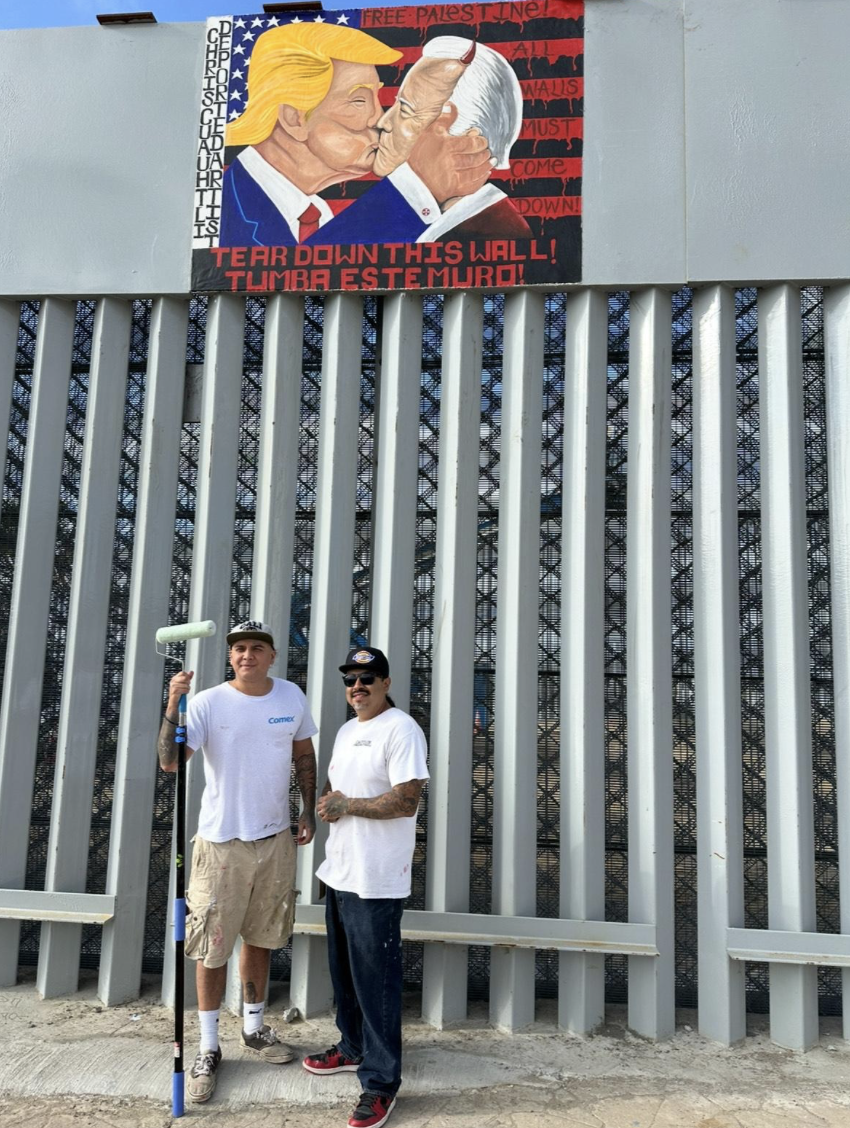
Chris Cuauhtli (left) and Javier Salazar Rojas (right) stand beneath their revised mural of Trump and Biden at the newly-fortified border wall in Friendship Park, Tijuana, Mexico in March 2024. (Photo credit: Javier Salazar Rojas / @DeportedArtist)
After CBP’s replacement and expansion of the border wall at Friendship Park in August 2023, Rojas and Cuauhtli reprised their painting of Trump and Biden in March 2024. Their second mural highlighted the violence of the border wall while making an explicit protest of Israel’s genocide in Gaza. In the updated piece, Trump and Biden share a kiss against the backdrop of a distorted American flag. Its stripes are portrayed as trails of blood. Trump holds Biden’s neck, revealing the former’s arm and a cuff link featuring the symbol of the Ku Klux Klan. Biden is depicted with red horns and a crimson suit. In the stripes, a message of solidarity appears: “Free Palestine! All Walls Must Come Down!” At the bottom, a declaration in English and Spanish reads, “Tear Down This Wall!/ Tumba Este Muro!” The muralists’ revised artwork visualized the intimate relationships between involuntary displacement and migration, settler colonialism and carceral infrastructure. It appropriated the border’s physical infrastructure, using it as a canvas to link local violence exerted by the wall between Tijuana and San Diego to the global violence of border imperialism (Walia 2013) and apartheid in places such as Occupied Palestine. The painting revealed the bedrock of bipartisanship in U.S. governmental politics for what it truly is: a fatal romance with militarism, corporatism, and domination. This is embodied in the CBP’s massive and longstanding contracts with weapons manufacturers such as the Israeli-based Elbit Systems or San Diego’s General Atomics, both of which contribute to Israel’s ongoing genocide in Palestine.
As I write elsewhere, physical infrastructures often perpetuate cyclical violence in marginalized communities (Timmons 2026). Both artworks, in 2023 and 2024 respectively, deconstruct the discursive imaginaries underlying violent infrastructures by re-presenting them as monuments of unfreedom, terror, and national insecurity. The murals’ culminating statement—“Tear Down This Wall!/ Tumba Este Muro!”—envisions a political future absent of walls and the social hierarchies they sustain in cities like Tijuana and Gaza. It also nurtures political solidarities against imperial infrastructures from Occupied Palestine to the transborder region in Tijuana, Mexico. Where deadly barriers injure and divide, artistic intervention disrupts these infrastructures of violence and beckons a world without walls.
Ashly, Jaclynn. 2017. “Palestinians Hit Back at Graffiti Tourists.” Al Jazeera, December 27. https://www.aljazeera.com/features/2017/12/27/palestinians-hit-back-at-graffiti-tourists.
Beaubien, Jason. 2009. “Fence Supplants ‘Friendship’ At U.S.-Mexico Border.” World. NPR, February 9. https://www.npr.org/2009/02/09/100155361/fence-supplants-friendship-at-u-s-mexico-border.
Brambilla, Chiara, and Reece Jones. 2020. “Rethinking Borders, Violence, and Conflict: From Sovereign Power to Borderscapes as Sites of Struggles.” Environment and Planning D: Society and Space 38 (2): 287–305. https://doi.org/10.1177/0263775819856352.
Kalir, Remi. 2025. Re/Marks on Power: How Annotation Inscribes History, Literacy, and Justice. MIT Press. https://mitpress.mit.edu/9780262551038/remarks-on-power/.
De La Cruz Santana, Lizbeth. 2022. “Deported Childhood Arrivals ‘from the Famous Estados Unidos’ DREAMing in Tijuana.” In Migrant Feelings, Migrant Knowledge: Building a Community Archive. University of Texas Press. https://doi.org/10.7560/326220-006.
Maher, Kristen Hill, and David Carruthers. 2021. “The Making (and Unmaking) of a Bordered Imaginary.” In Unequal Neighbors: Place Stigma and the Making of a Local Border. Oxford University Press. https://doi.org/10.1093/oso/9780197557198.003.0003.
Mbembé, Achille. 2003. “Necropolitics.” Public Culture 15 (1): 11–40. https://muse.jhu.edu/pub/4/article/39984
Rodgers, Dennis, and Bruce O’Neill. 2012. “Infrastructural Violence: Introduction to the Special Issue.” Ethnography 13 (4): 401–12. https://doi.org/10.1177/1466138111435738.
Timmons, Rashad Arman. 2026. “Haunting Interruptions: Race, Infrastructural Violence, and Spatial Memory in Ferguson, Missouri, United States.” Antipode 58 (2): e70132. https://doi.org/10.1111/anti.70132.
Walia, Harsha. 2013. Undoing Border Imperialism. AK Press.