Reappearing in the City: Black Women Confronting Forced Disappearance in Colombia
archive

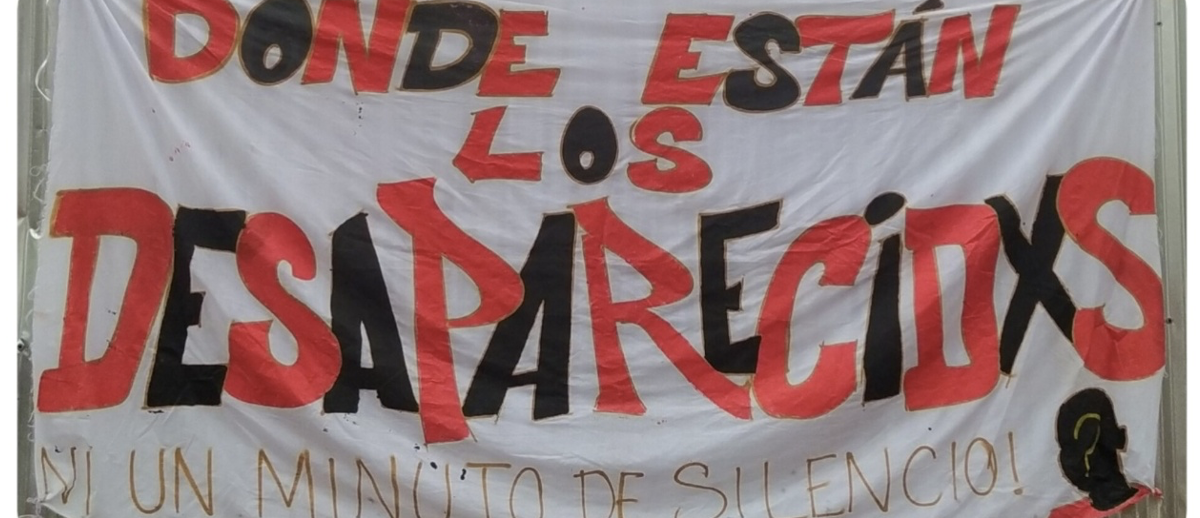
A photograph of the banner at the monthly meeting asks: Where are the Disappeared?. Photo by Fundación Guagua, used with permission
Reappearing in the City: Black Women Confronting Forced Disappearance in Colombia
In Colombia, forced disappearance is a wound that never heals. For Black women, however, that wound does not only mark the body: it shapes territory, everyday life, and future possibilities. In Cali, where thousands of people displaced by the internal armed conflict have settled on the city’s margins, disappearance has become a structural element of urban life. It is not merely a crime; it is a way of ordering space, of delineating who is entitled to full existence and who is relegated to the shadows. This article reflects on the geography of forced disappearance and highlights how Black women have transformed the absence of their loved ones into a radical political practice that reconfigures the very meaning of life in the city.
Disappearance and Antiblackness
In a country under a six-year armed conflict, Colombia has become a machine of disappearance and terror. In the most recent reporting period, between January and June 2024, the Unit for Victims documented 96,844 persons affected by forced displacement, either individually or collectively, with a significant proportion of these events concentrated in the Pacific region (Unidad para las Víctimas, 2024). According to consolidated data in the year 2024 from the Unit for the Search of Persons Deemed Disappeared (UBPD), as of recent reporting periods more than 113,442 people remain forcibly disappeared, the majority in connection with the armed conflict and its structural effects (UBPD, 2024). Complementarily, the National Center for Historical Memory and the Truth Commission have documented that disappearances occurred in nearly all municipalities across the country, including highly racialized regions such as the Pacific departments (Valle del Cauca, Chocó, Cauca, and Nariño), where Afro-descendant populations constitute a significant share of the population and, consequently, of the victims (Centro Nacional de Memoria Historica 2018; Comision de la Verdad, 2022). Although official systems have yet to publish fully disaggregated data by ethnic group that would allow for quantifying the exact proportion of Afro-descendant persons among the forced disappeared, multiple reports concur that Black communities in the Pacific region have been overrepresented within the territorial logic of forced disappearance.
There is broad consensus among scholars and activists that violence in the Pacific region has been driven by economic, geostrategic, and political interests tied to extractivism, infrastructure projects, and illicit economies. In this context, forced disappearance functions not as an aberration but as a technology of territorial control. Drawing on Ruth Wilson Gilmore’s (2007) notion of “organized abandonment,” disappearance can be understood as part of a broader process through which racialized populations are exposed to premature death through the systematic withdrawal of protection and care.
This is also a gendered phenomenon. Having fled their territories to protect their lives, Black women arrive in cities such as Cali hoping to rebuild their projects, only to encounter renewed persecution and exclusion. In this context, women often express that they “cannot stay here, but cannot go back either”—a phrase that captures the liminal condition of black displacement: there is no possibility of return, yet no full integration into urban life. In Cali, one of Colombia’s most unequal cities, they live in the predominantly Black eastide which concentrates the highest levels of poverty and highest concentration of internal refugees (Moreno, 2022; Alves, 2020). This demographic distribution is not accidental; it is the outcome of centuries of policies that have shaped territory through racial exclusion.
Forced disappearance—although embedded in broader dynamics of the armed conflict—interlocks with antiblackness. These processes can be read dialoguing with Achille Mbembe to understand the configurations of power in post-colonial contexts. This author states that ‘the politics of cruelty’ has shifted throughout history producing a specific terror formation called necropower. Forced disappearance appears through the practice of necropolitics, here understood as a government strategy (Mbembe, 2003). In the context of Colombia, the process of making people disappear appears as an expression of death, but unlike Mbembe who understands death in a literal way, I understand necropolitics as the limbo state of neither being alive nor being dead. In my research context, necropolitics operates as a strategy of suspension of life or what we describe as a “living-in-death”: an existence traversed by continuous violence, uncertainty, and the systematic denial of mourning. Forced disappearance thus extends historical regimes of racial domination into the present where Black populations are rendered permanently disposable.
In this context, Black women, historically responsible for sustaining family and community life, are compelled to inhabit a suspended temporality. They wait, search, and demand answers while simultaneously working, providing care, and holding their families together. Their lives are marked by a double burden: the historical weight of racial violence and the contemporary violence of war. In this sense, forced disappearance is not only a practice that negates the body; it is also a mechanism that reproduces and renews the brutality historically inflicted upon Black communities.
An example of this fractured existence is the story of Saray, an Afro-descendant woman from Timbiquí, a predominantly Black municipality on Colombia’s Pacific coast. Her brother disappeared in 2019—the same year she was forcibly displaced. Shortly thereafter, she lost her husband and took responsibility for caring for her grandchild, who suffers from a terminal illness. Since then, Saray has spent much of her life moving between public hospitals and government offices, navigating bureaucratic systems in order to secure medical care for her grandchild and herself—care that is often denied by the very institutions charged with providing it. Her story condenses three central elements that shape the experiences of many Black women: forced displacement, urban violence, and the disproportionate burden of social reproduction. Saray’s experience is not exceptional. It reveals how disappearance operates as a force field that reorganizes everyday life. Women become trapped in endless bureaucratic procedures, empty official responses, rumors, and silences. For them, the city is not a neutral space; it is a territory where physical and social death overlaps and where searching for their loved ones and for rights becomes part of the urban landscape of disappearance.
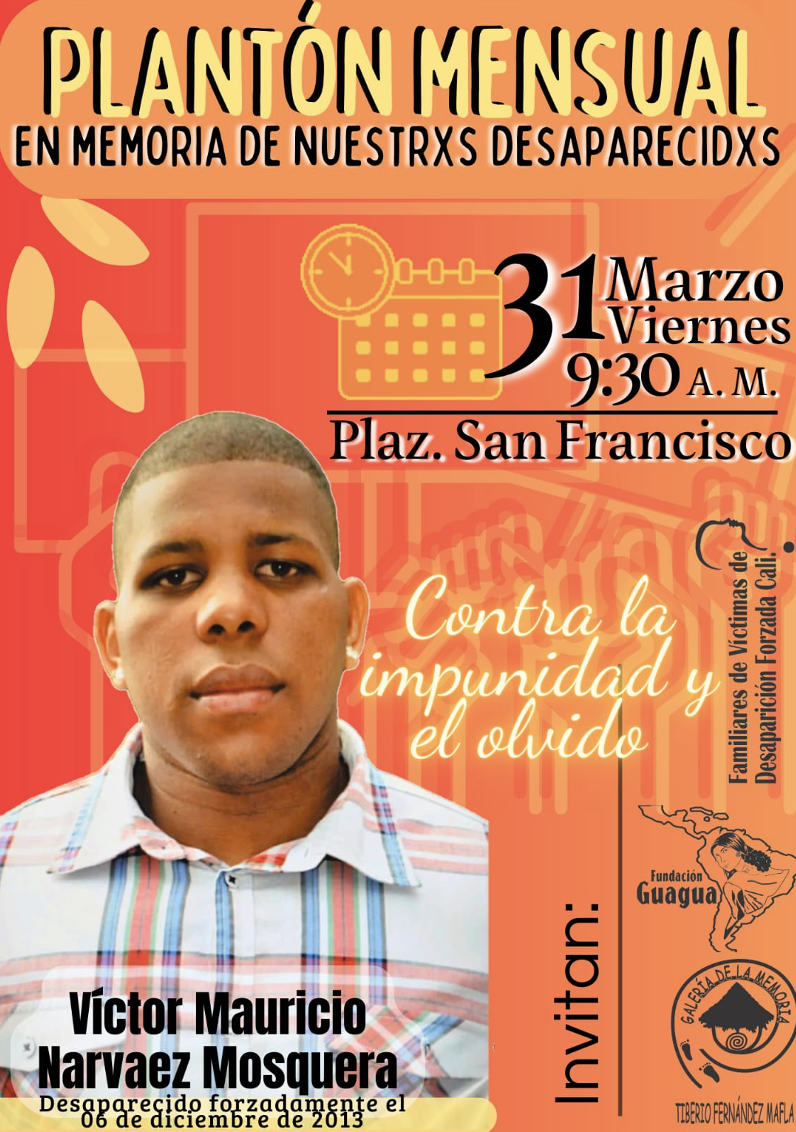
A photograph of Victor Mosquera, a young Black man “disappeared” on Dec 6, 2013. The flyer says: “Monthly Meeting in memory of the disappeared.” Photo by Fundación Guagua, used with permission.
Appearance as a Subversive Act
In a city Black bodies are made to disappear in multiple ways, there are thousands of women in situations similar to Saray’s. If forced disappearance denies the presence of loved ones, women respond with an inverse strategy: political appearance. In Cali, they organize monthly demonstrations in front of government buildings and prosecutorial offices. They install galleries displaying photographs, clothing, and handwritten messages; they speak with passersby, distribute flyers, and narrate what the state seeks to silence. These actions function both as public pedagogy and as spaces of collective care. Through them, women produce what might be described as a political occupation of public space. The practices documented in Cali resonate with women-led movements across Latin America. In Mexico, collectives of searching mothers have transformed maternal grief into a public denunciation of state violence, producing what Gatti calls a “politics of presence” in the face of absence. In Brazil, Black women—particularly mothers from favelas affected by police and paramilitary violence—have mobilized memory, motherhood, and territorial occupation as strategies of resistance against racialized regimes of death. Across these contexts, women’s activism reveals how disappearance and death are confronted through embodied, gendered, and spatial practices (Moreno 2022; Moreno and Mornan 2015).
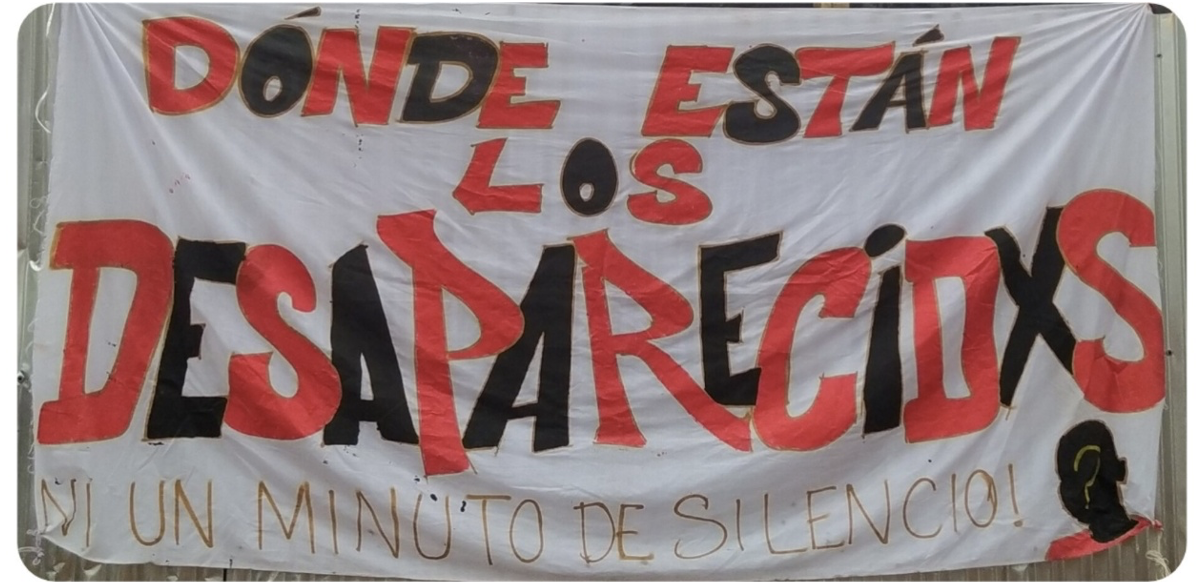
A photograph of the banner at the monthly meeting asks: Where are the Disappeared?. Photo by Fundación Guagua,
used with permission
This presence is profoundly subversive. Black women have historically been relegated to territorial and symbolic margins. By occupying the city center, they challenge the spatial order of racialization. If forced disappearance condemns their relatives to an ontological limbo—being and not being at once—women respond by asserting the right to name, to remember, and to demand justice.
Black women deploy a range of political strategies to preserve the memory of their loved ones. These include protests, marches, and chants demanding truth, justice, reparation, and guarantees of non-repetition. At the same time, women engage in intimate and creative practices that reinscribe the absent body and transform private grief into collective memory.
Saray, exemplify these practices. She weaves because it was something her brother loved to watch her do. This practice enact what geographer Katherine McKittrick has described as Black spatial agency: the capacity to produce life and meaning within landscapes structured by racial violence. As McKittrick (2006, 10) writes, Black geographies “are not only sites of violence but also spaces of possibility, resistance, and life-making.”
The city thus becomes a living archive in which absent bodies symbolically reappear. From domestic to public space, forced disappearance leaves both visible and invisible marks. Many women speak of stress-related illnesses, insomnia, loss of appetite, and anxiety. At the same time, they describe deep transformations: increased personal strength, an expanded capacity to speak publicly, and a renewed sense of purpose. For some, tattooing a child’s birthdate or wearing clothing printed with their image becomes a way of keeping them present. These bodily gestures reconfigure mourning, turning the body into a territory of memory and a political instrument.
Black women transform the city by shifting the boundary between the visible and the invisible. Their presence is not only physical but narrative: they dispute collective memory and challenge official accounts of violence. In a country where many disappearances are not investigated or are minimized, these women generate a public counter-archive.
Forced disappearance negates life, but their struggles restore it. Where the state produces silence, they produce memory. Where violence fragments, they weave community. Where the country forgets, they persist in asking: Where are they? This question does more than search for the missing; it demands a different country altogether.
Alves, Jaime A. 2020. “Biopólis, Necrópolis, ‘Blackpolis’: Notas para un Nuevo Léxico Político en los Análisis Socio-Espaciales del Racismo.” Geopauta 4 (1): 5–33.
Centro Nacional de Memoria Histórica. 2015. Una Nación Desplazada: Informe Nacional del Desplazamiento Forzado en Colombia. Bogotá: CNMH–UARIV.https://www.centrodememoriahistorica.gov.co/descargas/informes2015/nacion-desplazada/una-nacion-desplazada.pdf.
Centro Nacional de Memoria Histórica. 2024. Balance de desaparición forzada. Informe accesible en PDF. https://centrodememoriahistorica.gov.co/descargas/informes-accesibles/balance_desaparicion-forzada_accesible.pdf.
Comisión de la Verdad de Colombia (CEV). 2022. Informe de violaciones digital. Documento CEV con análisis de desaparición forzada y cobertura territorial. https://www.comisiondelaverdad.co/sites/default/files/2022-08/CEV_VIOLACIONES_DIGITAL_2022.pdf
Gilmore, Ruth. 2007. Golden gulag: Prisons, surplus, crisis, and opposition in globalizing California. University of California Press.
McKittrick, Katherine. 2006. Demonic Grounds: Black Women and the Cartographies of Struggle. Minneapolis: University of Minnesota Press.
Mbembe, Achille. 2006. “Necropolitics.” Raisons Politiques 21 (1): 29–60.
Moreno, María Vicenta. 2022. Entre la Dignidad y la Muerte: Mujeres Negras, Dominación Patriarcal y Estrategias Espaciales de Resistencia en el Oriente de Cali. Cali: Editorial Imago.
Moreno, Maria Vicenta., & Mornan, Debaye. (2015). ¿ Y el Derecho a la Ciudad? Aproximaciones al racismo, la dominación patriarcal y las estrategias feministas de resistencia en Cali, Colombia. CS, (16), 87-108.
Unidad de Búsqueda de Personas Dadas por Desaparecidas (UBPD). 2024. “141 personas con vida fueron encontradas por la Unidad de Búsqueda durante el 2024.” Accesed Dic 22, 2025. https://unidadbusqueda.gov.co/actualidad/resultados-busqueda-balance-nacional-2024/
Unidad para las Víctimas. 2024. “Desplazamiento Forzado en Colombia I semestre 2024.” Datos para la Paz. Accesed Dec 12, 2025. https://datospaz.unidadvictimas.gov.co/desplazamiento-forzado-colombia-primer-semestre-2024/