Time is Running Out: Embracing Reason at the Eleventh Hour
archive


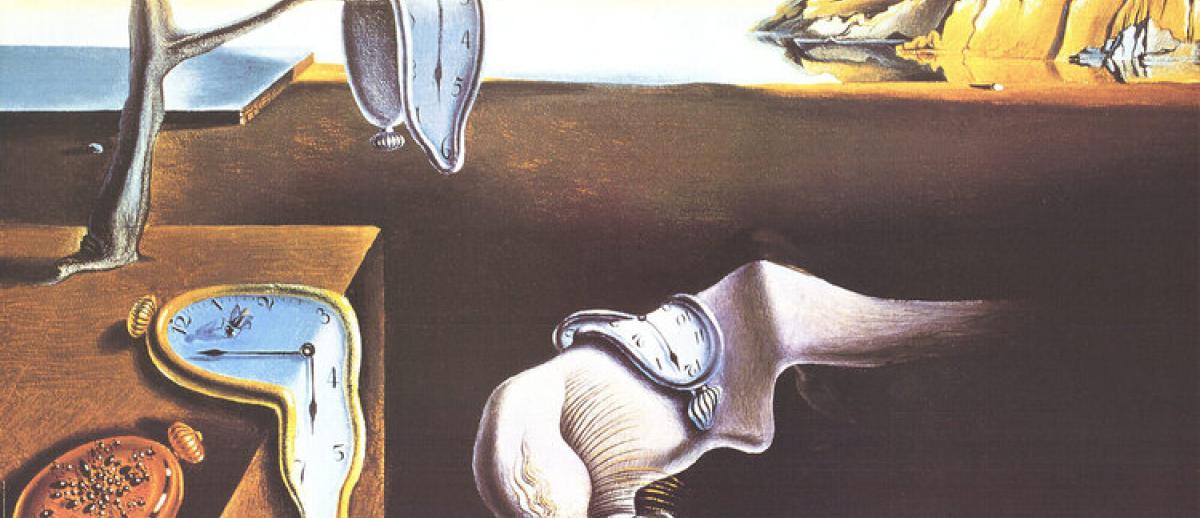
The Persistence of Memory by Salvador Dali, 1931
Time is Running Out: Embracing Reason at the Eleventh Hour
In world politics, nothing is disconnected. Though specific events, personalities and weapon technologies may appear to “stand alone,” they inevitably coalesce into one all-embracing structure of power and authority. Sooner or later, if the anarchic structure birthed at the 1648 Peace of Westphalia remains dominant, all states and peoples will face irreversible chaos.1
There are multiple particulars. Amid current wars and threatened aggressions2, global powers remain focused on immediate security threats (both real and imagined), not on longer-term world system transformations. For the most part, such policy shortsightedness is understandable. Still, humankind’s chronic indifference to needed security obligations suggests that no traditional remedies could possibly “work” over time. Significantly, this candid prognosis would remain valid even if all national leaderships were somehow well-intentioned and perfectly rational.
A medical metaphor will offer further clarification. To begin, we may think of a single patient’s disease being treated as an isolable harm rather than an organic pathology. Such treatment would “miss the point” because when dealing with biological disease processes, it generally makes little sense to tackle singular symptoms without first seeking systemic origins.
In dealing with variously manifested “pathologies” of world politics, capable thinkers should first acknowledge the underlying elements of interdependence. As with an individual human being, world politics needs to be treated as an organic “whole.” This network of systems is always more complex than the calculable sum of its “parts.”3 What should be done to rescue an imperiled planet from continuous self-delusion? Are visionary suggestions for transformative world order reform unrealistic ipso facto? In deference to Reason (ancient Greek philosophers called this “logos”), such suggestions are actually more realistic than staying true to a fatally-flawed geopolitics. Here we may purposefully recall the succinct wisdom of Italian film director Federico Fellini: “The visionary is the only realist.”
There is more. The overall challenge to survival in world politics is not “merely” conceptual. There are stubbornly complicated details to be identified and managed. In certain foreseeable cases, especially in our rapidly-dissembling Trump Era, failures of “Westphalian” international law would not only be catastrophic. They would be unprecedented. Or in the precise language of logic and scientific method, they would be sui generis.
What happens then? The answer is beyond any reasonable doubt. Recalling Swiss playwright Friedrich Durrenmatt: “The worst does sometimes happen.”
For every country’s foreign policy planners, especially US President Donald Trump, it is high time to take science seriously, not just as reassuring justification for self-driving cars and heated steering wheels, but for the prevention of a nuclear war. Simultaneously, a coinciding question will need to be raised: “What if we should suddenly or incrementally find ourselves in a nuclear crisis?” Such portentous queries already lie latent not just in Russian, Chinese, and North Korean activities, but also in the conspicuously incoherent policies announced by America’s White House.
Soon, all states, but especially those that rely on nuclear deterrence, should think deliberately and scientifically about alternative structures of world politics. While even the tiniest reference to global unification or integration (what French Jesuit philosopher Pierre Teilhard de Chardin calls "planetization") will be dismissed as fanciful, such operational “oneness” represents humankind’s only meaningful opportunity to “stay alive.” In essence, if left unrevised, the "every man for himself" ethos in world politics will spawn a grotesque and pitiless providence.
What are reasonably foreseeable narratives? At some not yet decipherable stage, world system failures could become force-multiplying and intolerable. For the moment, it could still be selectively rational for major states to use military force against certain dangerous enemies, whether sovereign states or sub-state terror groups. In the longer term, however, the only sort of realism that could make sense would point us toward acceptance of global “oneness.” Underscoring this Reason-backed argument is the verifiable failure of “balance-of-power” world politics.4
For the still-hidden prophets of a Reason-based world civilization, “oneness” need not be a bewildering notion. It is hardly a biological secret that the basic factors and behaviors common to all human beings greatly outnumber those traits that differentiate one human segment from another. Inter alia, unless the leaders of all major states can finally understand that the durable survival of any one state is contingent on the survival of all, true national security will remain impossible. This conclusion is as true for the “powerful” United States, Russia and China as for the allegedly weak states in world politics.
Fortunately, there are still-remaining intellectual opportunities for world order visionaries and wise national leaders. To considerable extent, these opportunities lie latent in the foundational insights of Francis Bacon, Galileo, Isaac Newton, Sigmund Freud, Carl G. Jung, Karl Jaspers and Lewis Mumford: "Civilization,” Mumford sums up, “is the never ending process of creating one world and one humanity." There is more. “Powerful” states ought never allow themselves to be lulled into sleep by nearsighted calls for military "victory." For humankind in its entirety, the only triumph worth celebrating could be one that transports planetary politics beyond millennia of bloody hatreds and doctrinal anti-Reason.
In this regard, the American president’s visceral attachment to law-violating aggressions undermines civilized international relations. The clearest example of this destructive attachment is Donald Trump’s de facto support of Putin aggressions against Ukraine. Under authoritative international law, these represent Nuremberg-level crimes of war, crimes against peace and crimes against humanity. Policy-makers and scholars will need to think more urgently and systemically about alternative world futures. Otherwise, an entire planet will suffer grievously from the remorseless “Westphalian legacy,” a continuously-defiling inheritance of war, terrorism and genocide. Then, following dramatist Friedrich Durrenmatt’s eleventh-hour warning, the “worst” will actually happen.
A final imperative about listening to Reason. While it might sound banal, time is “running out.” Jean Jacques Rousseau, the Enlightenment philosopher so important to 18th century American political thought, once wrote prophetically: “The majority of nations, as well as of men, are tractable only in their youth. They become incorrigible as they grow old.” Today, incorrigibility is everywhere the norm.
A closing summation. Where it is understood in terms of humankind’s obligation to replace belligerent nationalism with organic world politics, this requirement suggests something of utterly overriding importance: Though certain residual survival options remain graspable, they are also fleeting.
1) During chaos, which is a "time of War," says English philosopher Thomas Hobbes in Chapter XIII ("Of the Natural Condition of Mankind, as concerning their Felicity, and Misery."): "... every man is Enemy to every man... and where the life of man is solitary, poor, nasty, brutish, and short." At the time of writing Leviathan, Hobbes believed that the condition of "nature" in world politics was less chaotic than that same condition among individual human beings. This is because of what he called the "dreadful equality" of individual persons in nature, an equality concerning the presumed ability to kill others. However, this once-meaningful differentiation has effectively disappeared with the continuing manufacture and prospective spread of nuclear weapons.
2) US President Donald Trump’s law-violating threats of aggression against Greenland, Mexico, Colombia, etc., should come immediately to mind. From the standpoint for formal logic, these threats are examples not of Reason, but of fallacious appeals to armed force (argumentum ad bacculum).
3) In philosophy of science terminology, this means “synergy.”
4) The idea of a balance of power - an idea of which the nuclear-age balance of terror is merely a variant - has never been more than a facile metaphor. It has never had anything to do with ascertaining equilibrium. As such, balance is always more-or-less a matter of individual subjective perceptions. Adversarial states can never be sufficiently confident that identifiable strategic circumstances are actually "balanced" in their favor. In consequence, each side must perpetually fear that it will be left behind, creating ever wider and cascading patterns of both insecurity and disequilibrium.