Toward a New Relational Ethics Reimagining Relations Between the West, Nigeria, and the Kingdom of Benin
archive

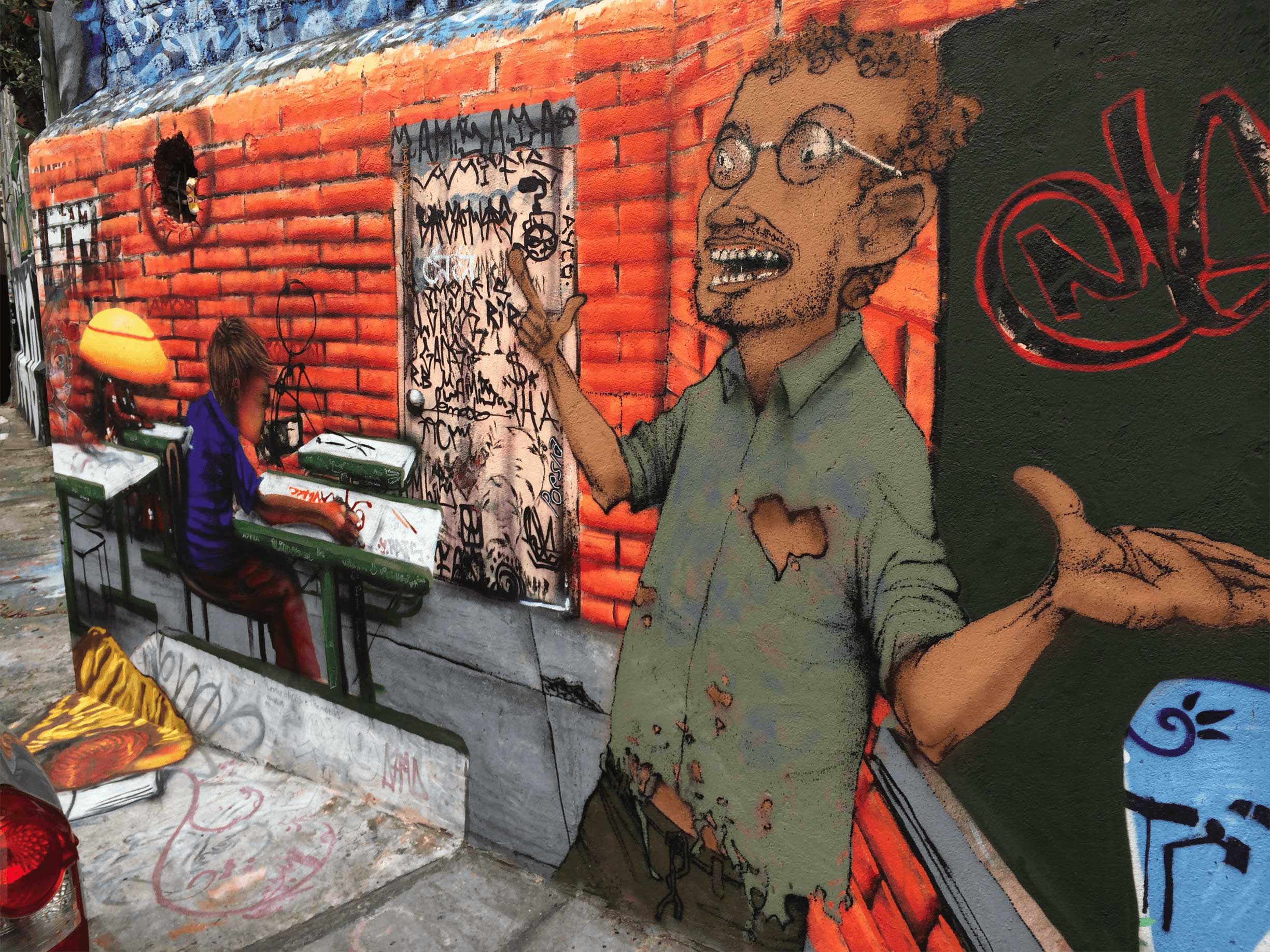
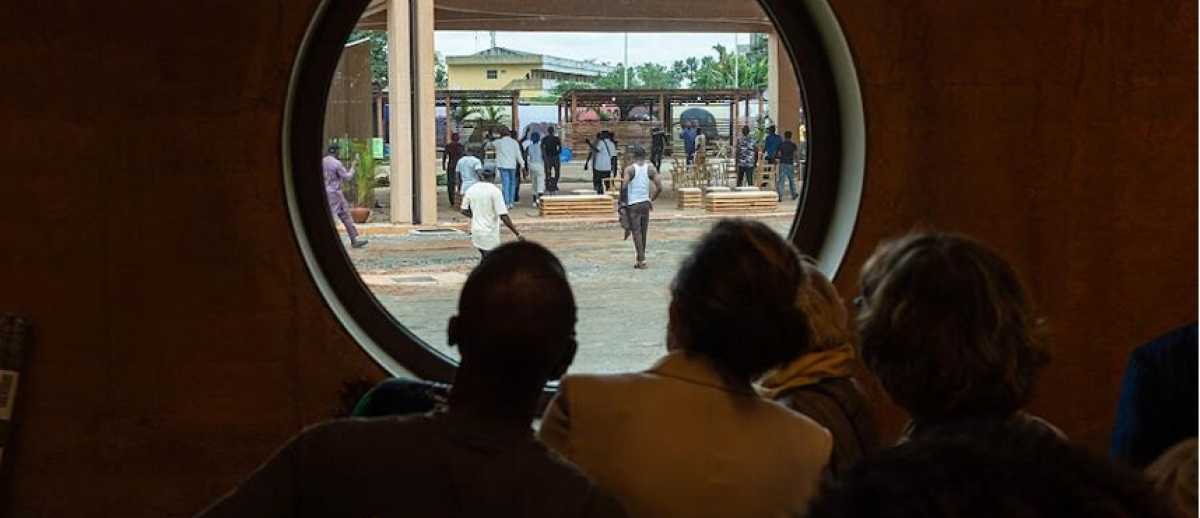
Toyin Adedokun/AFP, Opening of the Museum of West African Art, November 9, 2025.
Toward a New Relational Ethics Reimagining Relations Between the West, Nigeria, and the Kingdom of Benin
The return of African cultural objects from Western collections to communities of origin is not the end of a process of restorative justice. Rather, it is just the beginning. Advocates for the return of African cultural objects have seen important victories in recent years, particularly with the Benin bronzes and other artworks from the Kingdom of Benin. In 2022, the Smithsonian's National Museum of African Art returned twenty-nine bronzes to Nigeria's National Commission for Museums and Monuments. In 2023, the University of Cambridge pledged over a hundred. In 2025, the MFA Boston returned two bronzes to Oba Ewuare II, the king of Benin and the great-great-grandson of Oba Ovonramwen, who was king when the British invaded and looted the royal palace in 1897. This return was related to the opening of the Museum of West African Art (MOWAA) in Benin City, which was billed as a leap forward in Nigeria’s efforts to reclaim and rehouse its cultural heritage. In the early stages of development, MOWAA pledged to collaborate with the Oba of Benin in displaying his ancestors’ stolen heritage. The museum, located a stone’s throw from the royal palace, was supposed to be a monument to new collaborative possibilities – both between Africa and the West and between national governments and local communities.
Despite these victories, the relations between Africa and the West have remained fundamentally unchanged. African cultural objects were taken from the continent as part of the dual projects of Western imperialism and resource extraction. As the archaeologist Dan Hicks argues in his book, The Brutish Museums: The Benin Bronzes, Colonial Violence and Cultural Restitution, Britain’s looting of Benin and its bronzes is the direct result of “corporate militarist colonialism.” In 1897, the British claimed to attack the Kingdom of Benin as part of a “punitive expedition,” but the Royal Niger Company had determined to take the kingdom years prior. The company’s private, commercial interests came together with state violence and eventually, formal annexation.1
The result of this “corporate militarist colonialism” was the expropriation of labor, land, and natural resources – as well as cultural objects like the Benin bronzes. British soldiers auctioned off the bronzes, carved tusks, and other cultural objects looted from the oba’s palace to pay for the costs of the expedition. The loot paid for the looting. The best specimens were sent to the British Museum. As Hicks argues, the private commercial interests of the Royal Niger Company integrated seamlessly with the acquisitive goals of the British Admiralty and Foreign Office as well as those of the British Museum. This might be called a “public-private partnership” of the sort that has devastated African nations since independence. The corporate militarism pioneered in the Kingdom of Benin, Hicks argues, marked a significant step toward the contemporary, neocolonial, and neoliberal world order.2
While the successful return of cultural objects like the Benin bronzes are a start on the path toward restorative justice, the significance of these returns is undermined when the economic and political relations between Africa and the West remain unchanged. In the twenty-first century, as in the nineteenth and twentieth centuries, the West treats Africa as a site of resource extraction. The kind of corporate militarism that Hicks describes continues today with new actors like the International Monetary Fund and World Bank. Now, as then, private commercial interests work together with state and paramilitary violence to form so-called “public-private partnerships” in mining, energy, and infrastructure. These neocolonial, neoliberal structures transfer value from the many to the few. Furthermore, they typically export value from Africa to the West. This can occur through capital flight from the continent to the old imperial capitals, now financial centers, such as London. It can also occur through the removal of raw materials from the continent to be refined elsewhere and sold back to Africans as finished products.
Making “African Art”
African art is hardly unrelated to this process. Rather, it is integral to defining the relationship between Africa and the West. African cultural objects are both emblematic of these existing, extractive relations and constitutive of them. European soldiers, settlers, and adventurers took African cultural objects from the continent and at first, made little use of them. Until the 1930s, Westerners saw African cultural objects as colonial trophies, ethnographic curiosities, and the occasional source of artistic inspiration. Avant-garde artists bought and sold “exotic” objects among themselves, but they did not yet have a broad market appeal. Even the Benin bronzes, which European recognized as having outstanding artistic quality, did not command the market interest that one might expect.
In 1898, just one year after the British “punitive expedition” against Benin, Lieutenant-General Augustus Pitt Rivers purchased a plaque that had been torn from the walls of the royal palace in Benin City. A retired army officer and amateur archaeologist, it is not surprising that Pitt Rivers was interested in military trophies from the Kingdom of Benin, then occupied by British forces. What is surprising is that he purchased the plaque from two booksellers, James and Mary Lee Tregaskis, for the meager price of £24, about £4,000 or $5,400 today.3 Comparable plaques sell for tens to hundreds of thousands of dollars at auction houses like Christie’s and Sotheby’s. Some plaques entered the collection of Pitt Rivers’ eponymous museum at the University of Oxford, where the archaeologist Dan Hicks is a curator and critical voice. The plaque that Pitt Rivers originally purchased in 1898 was sold to a succession of art dealers between 1957 and 1958. It was finally purchased by Nelson A. Rockefeller, scion of one of the world’s wealthiest families, trustee at the Museum of Modern Art, and soon-to-be-elected Governor of New York. It is not known how much Rockefeller paid for the plaque but suffice to say, it was rather more than £24.4
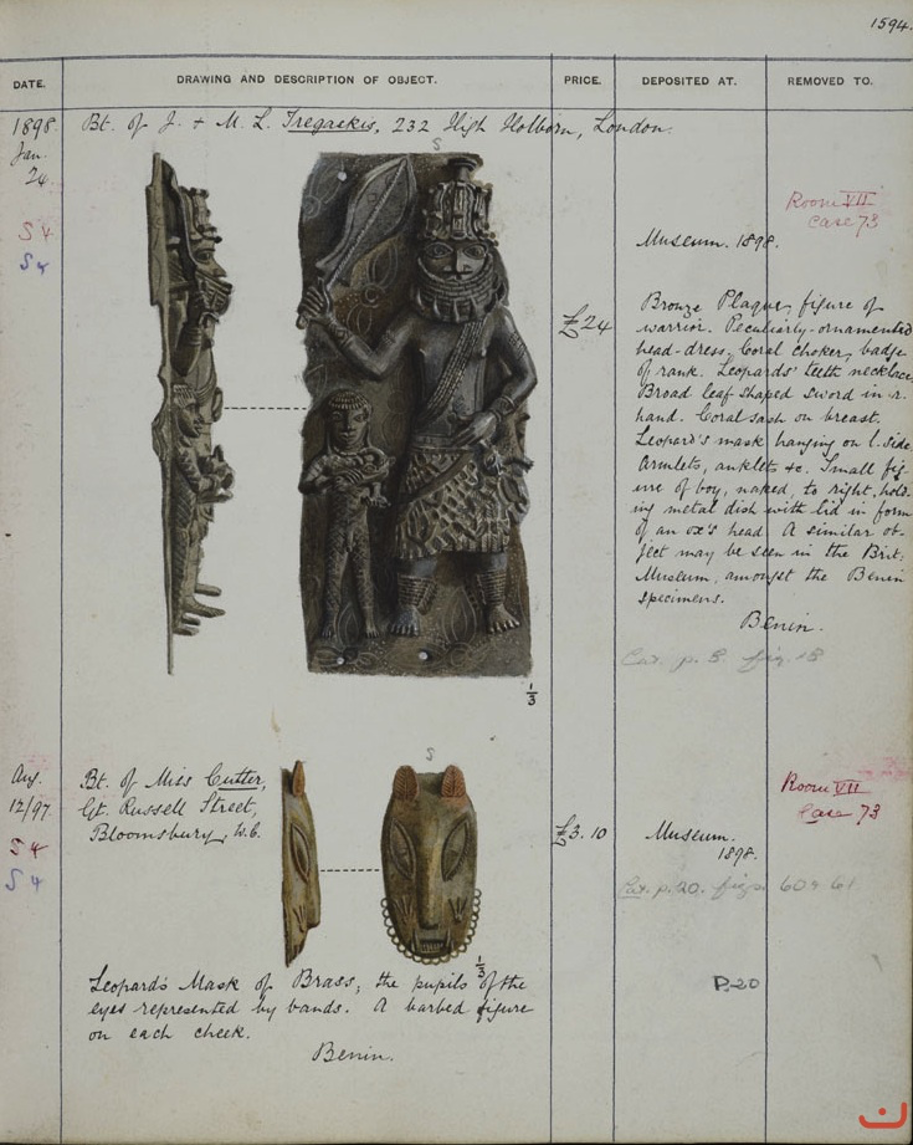
Benin bronze plaque depicting a royal commander and attendant from the Pitt Rivers Farnham collection catalogue.
Pitt Rivers Museum at the University of Oxford.
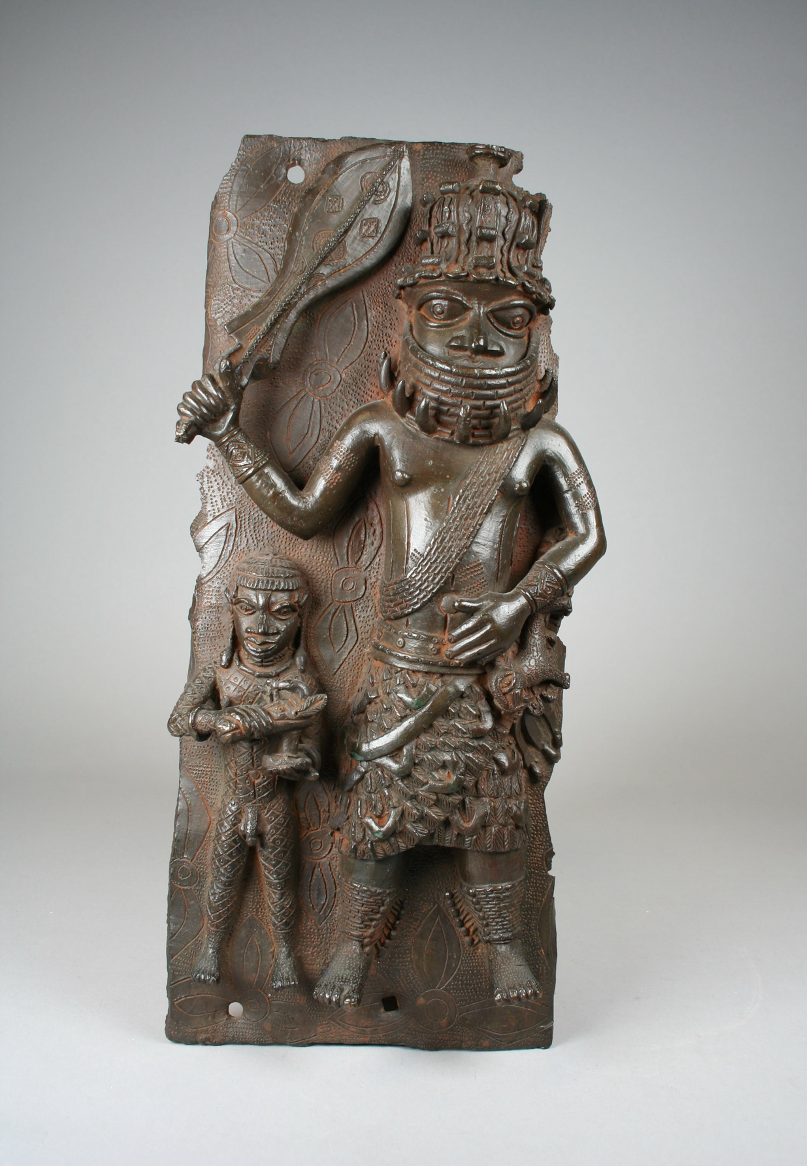
Ìgùn Ẹ́rọ̀nwwọ̀n (brass-casting guild) artists, Plaque with Ìyàsẹ́ (Royal Commander) and Attendant, ca. 1540–70.
Metropolitan Museum of Art.
The market value of African cultural objects increased dramatically in the early twentieth century because they were transformed into “African art.” African cultural objects had appeared in Europe for millennia, but they were not initially valued as “art” during the Scramble for Africa. To many Westerners, African cultural objects were raw materials. They could be appreciated and appropriated by avant-garde artists. But to be valued as “art” by wealthy buyers, they had to be “refined” like crude oil or “seasoned” like so many millions of enslaved Africans.
André Level, a French art dealer who speculated in the emerging market for “modern art” like Pablo Picasso, also promoted “African art” as its own market segment. In 1919, Level and Henri Clouzot published one of the first books on the subject, L'art nègre et l'art océanien. The book combined scholarship with personal financial interest. As the table of illustrations reveals, most of the objects discussed come from Level’s own collection. While he was in possession of some fine cultural objects, Level was also a dealer promoting his own stock. He was self-consciously creating the first Western “canon” of “African art,” with his own objects as its masterpieces.5
In a posthumous autobiography, Souvenirs d'un collectionneur, Level discusses the importance of being first to market. “It was at Matisse’s in 1914 that I was touched by grace before the first black sculptures I saw,” the dealer remembers. “But when I later met Derain, then Vlaminck, and finally other artists, I heard almost every one of them claim the privilege of being the oldest slave trader” (le privilège d'être le plus ancien négrier)6. Level’s remark betrays the competitiveness between African art’s “early adopters.” This amounts to nothing less than a doctrine of discovery. Level might not have been the first Westerner to appreciate African art as such, but his place in the scholarship and in the market depended upon staking an early claim. His analogy with the slave trade is as revealing. Level and his fellow négriers saw African cultural objects as raw materials. They needed to be dehumanized and deracinated to be valuable as commodities.
Making the “Benin Bronzes”
The French art dealer, Charles Ratton was the first to transform African cultural objects into “African art” at a major scale. He did so first through the art market, organizing the first major auction of “sculptures” from the colonial margins. Ratton became an “expert,” a legal status in twentieth-century France that entitled Ratton to organize sales at the auction house consortium, Hôtel Drouot. As an “expert,” Ratton could be trusted to inform potential buyers about the nature of these unfamiliar objects. Ratton could describe their age, use, and place of origin as well as their so-called “authenticity.” The dealer could determine which cultural objects counted as “art.” He began to define a canon of African art, as Level had in L'art nègre et l'art océanien.7
Like Level, Ratton defined his canon according to objects’ ownership rather than their original cultural significance. Just as Level had elevated objects from his own collection as models for l'art nègre, Ratton drew upon the names of European collectors to establish social proof for this speculative new market. The dealer billed his first auction at Hôtel Drouot in 1931 as the sale of a pioneering private collection, that of the Surrealist artists André Breton and Paul Éluard. Breton and Éluard were among the first adopters of “African art” as a category, people who Level might have called les plus anciens négriers. By linking the success of his auction to the names of these artists, who had more established markets for their own work by comparison, Ratton bolstered consumer confidence in his offerings. In the auction catalogue, the actual objects are reduced to pure visual forms and the names of their collectors. No Africans are given credit. Indeed, Breton and Éluard are the only artists named in the catalogue at all.8
Ratton’s bet proved successful. The dealer’s début auction was a commercial and critical success. It showed that African cultural objects could be valued – literally, turned into economic value – as “art.” However, this value to white, Western collectors was contingent upon their ownership by white, Western collectors. In his book, Making History: African Collectors and the Canon of African Art, the art historian Sylvester Okwunodu Ogbechie argues that the African art canon literally values objects with Western provenance over comparable objects owned by Africans. African cultural objects are deemed “inauthentic” when they come directly from African cultural producers themselves, or without the proper mediation by “experts” like Ratton. Cultural objects are only deemed “authentic” when they have been sufficiently mediated by Western authorities. “The object’s history of Western reception supplants its indigenous meaning,” Ogbechie writes, “and this serves to export the equity value of the artwork from its African producers to Western collectors.9” Ironically, the objects that Ratton bought and sold were considered more “authentic” the more they obscured their history of African ownership. African cultural objects were deemed less “authentic,” and therefore less valuable, the more they betrayed their African roots.
Ratton parlayed his commercial success into institutional validation, and he adapted his formula seamlessly from the auction house to the museum. In 1932, just a year after his début auction, Ratton organized an exhibition of cultural objects from Benin at the Musée d'Ethnographie du Trocadéro in Paris. This was the first “blockbuster exhibition” of “African art” and it marked the transformation of looted cultural objects from the oba’s palace into the famous “Benin bronzes.”
Between his auction at Hôtel Drouot and the opening of the exhibition at the Trocadéro, Ratton embarked on a buying trip to the United Kingdom. There, the dealer took advantage of an economic downturn and the general lack of appreciation for the cultural products of Benin at that time. Ratton purchased plaques, heads, and other artworks representing the oba and his court – and he purchased them on the cheap from British collectors like Pitt Rivers, who did not yet understand their value. Ratton was joined on the trip by Georges Henri Rivière, the director of the Trocadéro, blurring the lines between private interests and supposedly public institutions.
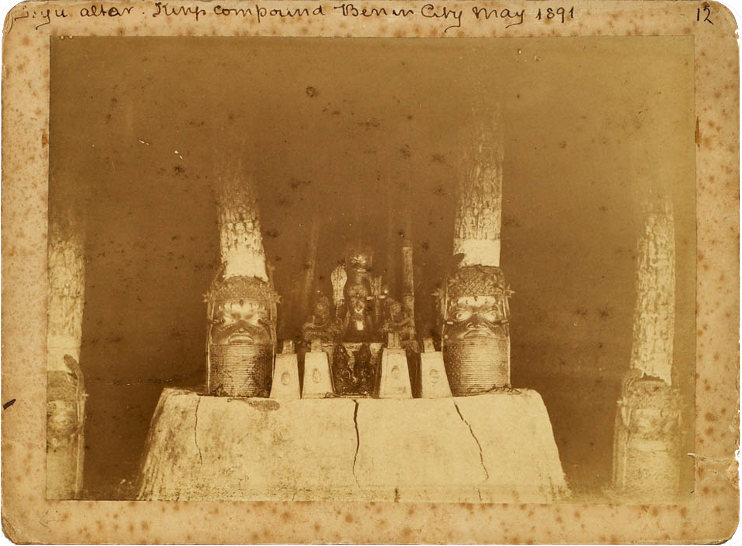
Cyril Punch, earliest known photograph of an altar in the oba's palace in Benin City, 1891.
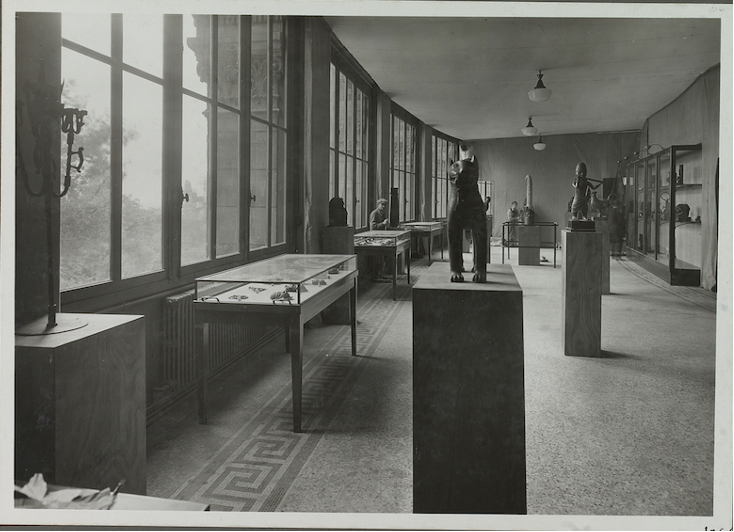
L’Exposition de bronzes et ivoires du royaume de Bénin, Musée d’ethnographie, 1932.
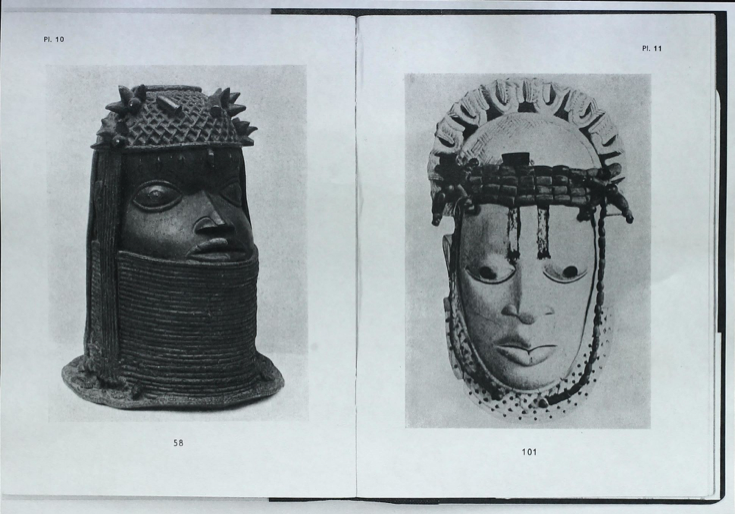
L’Exposition de bronzes et ivoires du royaume de Bénin, Musée d’ethnographie, 1932.
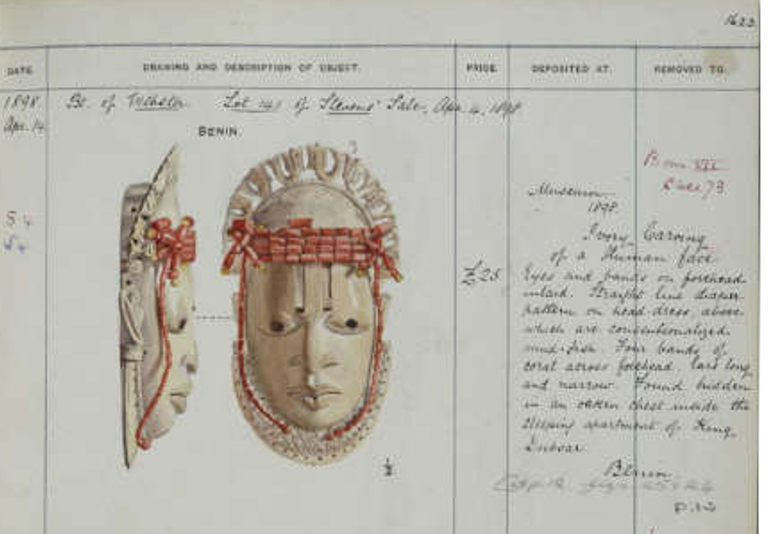
Ivory mask depicting the Iyoba (Queen Mother) from the Pitt Rivers Farnham collection catalogue. Pitt Rivers Museum at the University of Oxford.
Ratton and Rivière’s exhibition catalogue follows the same protocols that the former laid out in his auction catalogue the year prior. In both the auction and the exhibition catalogues, the names of owners are given pride of place. In many cases, Ratton himself is the owner, using his own personal collection to bolster the exhibition and vice versa. In other cases, the owners of the objects anonymous. The catalogue simply states that these objects are loaned from a “Coll. De M. X., Paris.” Ratton derives much of the value of his objects from the identities of their notable Western owners. This is true even when the collectors are anonymous. They are still, presumably, notable Western owners.
As with the Hôtel Drouot auction catalogue, the Trocadéro exhibition catalogue pictures Benin’s stolen heritage as isolated artworks against neutral backgrounds. There is no indication of how they were used, how they appeared in shrines that the obas erected to their ancestors, or how they got from Benin to Paris. Typology is the only relationality. Ratton and Rivière compare different types of heads, for example, setting the bronze head of an oba against an ivory mask depicting the Iyoba or Queen Mother, Idia. The catalogue does not explain who Idia was or why she was so important to the history of Benin. It does not convey a sense of how the ivory, a pendant mask worn at the waist, would have appeared as part of a greater ensemble of coral, cloth, and beads. Instead, the catalogue only provides a physical description, measurements, and of course, credit to the owner.10
This mask honoring the Iyoba, Idia embodies the story of the Benin objects to date. It was carved to honor the Queen Mother of Oba Esigie, who reigned from 1504 to 1550. The Iyoba supported her son’s rule militarily as well as diplomatically. She served as an important army commander, which is why she appears with a crown of electric catfish. The Iyoba balances beauty with the ability to shock in self-defense. She also exhibits signs of scarification in the two bars above her eyes, which further demonstrate her strength and ability to withstand pain. These bars would have originally been filled with iron, giving the mask additional shine, texture, and gravity. Lastly, the Queen Mother sports curls of coral and trade beads around her head. These beads were variously associated with Olokun, the orisha of the sea; the oba, who wears coral regalia; and the Portuguese, who began trading with the Kingdom of Benin in the 15th century, bringing precious trade goods like beads and brass.11
The mask of the Queen Mother passed from oba to oba until 1897, when it was found hidden in the bedroom of Oba Ovonramwen by invading British soldiers. Despite its obvious artistic merit and precious materials, European buyers and sellers did not particularly value the mask beyond its status as a colonial trophy or an ethnographic curiosity. In 1898, just a year after the invasion, Lieutenant-General Pitt Rivers purchased the mask for £25. It merited just one more pound than the plaque he bought in that same year. This masterpiece of Benin craftsmanship, one of only five comparable masks in the world, was worth the equivalent of just £4,100 or $5,600 today.12
Ratton’s interventions in the market and the museum world changed this. Ratton’s public-private partnership with the Trocadéro secured Benin’s cultural objects a special place in his emerging “canon” for “African art.” His inclusion of the Queen Mother mask secured it and the few like it status as particularly valuable. According to Christoph Rippe at the Linden-Museum Stuggart, this mask left the Pitt Rivers family collection in the 1930s, just as its investment value started to climb. Pitt Rivers’ grandson gave it to the art dealers, John and Gertrude Hunt, who allowed their investment to mature for another three decades. In 1964, the dealers sold the mask to the Linden Museum. It is unclear exactly how much the Hunt or Pitt Rivers families benefitted from these sales, but the market value of the mask had exploded since the time of the invasion of Benin, thanks to Ratton and his marketing blitz.13
Return
In 2022, the Linden Museum transferred ownership of the Queen Mother mask and sixty-nine other Benin objects to Nigeria. The country declared its independence from Britain in 1960, just a few years before the Queen Mother mask was sold to the Linden Museum. The oba at the time, Akenzua II, had begun the movement to return his kingdom’s stolen heritage. He found limited success recovering the stolen bronze heads of his ancestors and ivory carvings like the mask of Idia, an important figure in his dynasty.
Later obas, Akenzua II’s son and grandson, have continued to advocate for the return of their stolen heritage. Akenzua II’s son, Oba Erediauwa, received a pair of Benin bronzes delivered directly into his care from Mark Warner, a descendant of one of the original looters of Benin. Oba Ewuare II, Erediauwa’s son and the reigning king in Benin, has overseen more complicated repatriation cases. For example, the Netherlands returned a record 119 bronzes from its state collections to Nigeria’s state collections, the National Commission for Museums and Monuments (NCMM).
The NCMM retained ownership of four bronzes but returned the remainer to their rightful owner, Oba Ewuare II of Benin. They were less generous with the Idia mask from the Linden Museum, which remains in the national government’s control. The NCMM might reasonably argue that it has an overriding interest to retain four out of the 119 bronzes returned from the Netherlands for the benefit of the public. Though ironically, this is identical to arguments made by Western museums against returning objects. The same argument cannot be made of the Idia mask from the Linden Museum. It is one of only five like it. The others remain outside of Nigeria with no prospect of returning any time soon: one is at the British Museum, a second at the Metropolitan Museum of Art, a third at the Seattle Art Museum, and a fourth at Al-Thani collection in Paris.
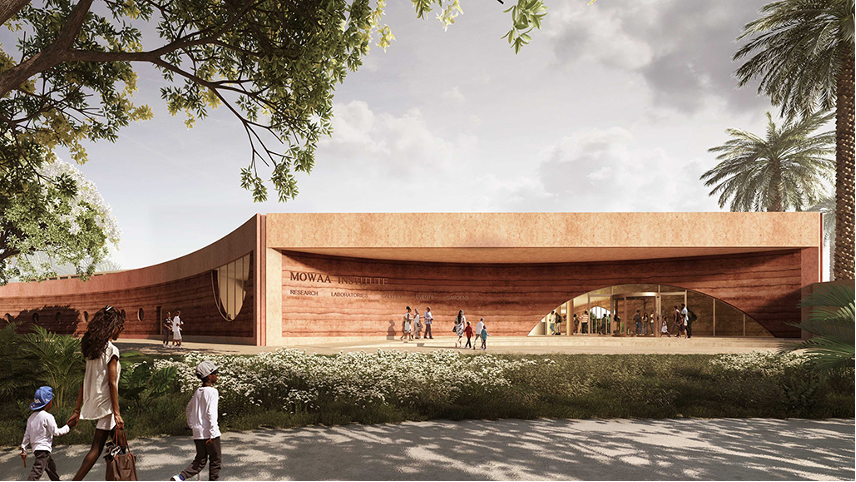
Adjaye Associates, Museum of West African Art (MOWAA) Institute, 2020.
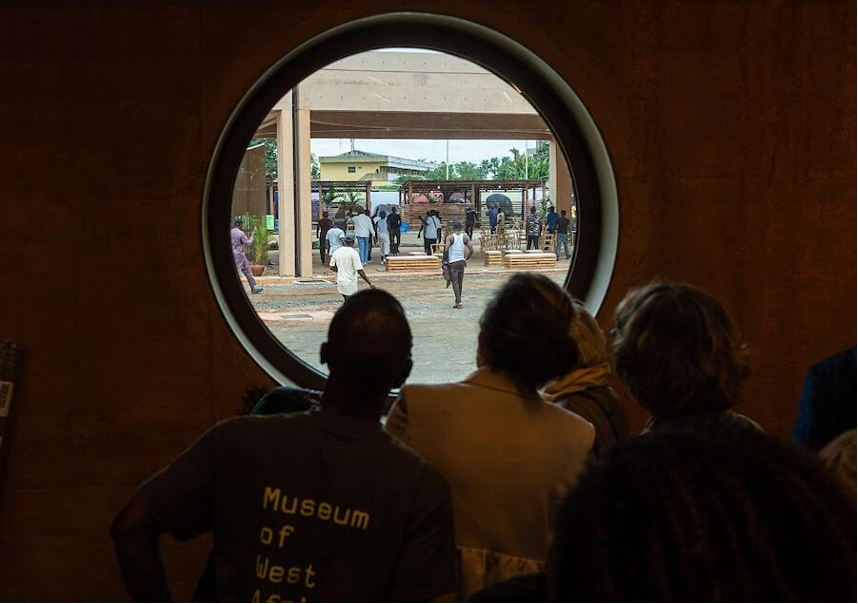
Toyin Adedokun/AFP, Opening of the Museum of West African Art, November 9, 2025.
The fissures between the oba and the national government revealed themselves in the opening of the Museum of West African Art in Benin City. The museum was first proposed in 2020 by the then governor of Edo State, Godwin Obaseki. The project successfully raised millions of dollars from the Edo State government, the German and French governments, and the British Museum, itself a conspicuous opponent of repatriation. The donors, then, were largely foreign and were themselves in control of much of Benin’s stolen heritage. From the start, MOWAA suffered from inherent contradictions. To some, it appeared as a beacon for Benin City, for Nigeria, for Africa, and for the entire Global South to reclaim its stolen heritage. To others, it appeared as yet another public-private partnership in the service of maintaining existing power relations.
The contradictions heightened in 2023 when the then president of Nigeria, Muhammadu Buhari, declared that any repatriated bronzes were the rightful property of the Oba of Benin, Ewuare II. The museum’s foreign donors all remained in staunch opposition to returning the Benin bronzes to Nigeria, let alone to a non-sovereign monarch. The suggestion flew in the face of their original investment deals with the national and state governments of Nigeria and Edo, respectively. It also upset the Western donors’ more foundational assumptions about nation-to-nation diplomacy and Westphalian international relations. The foreign donors, many of them foreign governments and government institutions like British Museum, could not imagine dealing directly with a non-state actor like the oba. It did not matter that the Kingdom of Benin had been a distinct and sovereign entity for centuries compared to Nigeria’s decades, or that its own international relations with European powers went back to the fifteenth century.Furthermore, Buhari’s declaration that the bronzes belong to the oba flouted Western conceptions of value established by art dealers like Charles Ratton and museum directors like Georges Henri Rivière. In Ratton and Rivière’s schema, African cultural objects are made valuable by virtue of their provenance. The “right” ownership, especially ownership by notable Westerner collectors or museums, transforms objects into “works of art.”
As Ogbechie writes in Making History: African Collectors and the Canon of African Art, African ownership of African cultural objects actually makes them less valuable in a system designed to export value away from the continent. The implication is that the repatriation of the Benin bronzes, especially to a non-state actor like the oba, threatens the entire system of value creation. It threatens to stem the flow of extraction.
These foundational differences came to a head with the opening of MOWAA in November 2025. The Edo State government changed the name from the “Edo Museum of West African Art” to the “Museum of West African Art” to achieve broader appeal for its mostly foreign donors. The oba, Ewuare II, protested. He claimed that the government had denuded the museum of its original purpose and subverted royal claim to the bronzes. The government’s move was a continuation of the looting, commodification, and institutionalization of the bronzes by European powers, many of whom were financially supporting the new museum. In response, Godwin Obaseki, the Edo State governor revoked the museum’s land license.
To add insult to injury, Edo State, Nigeria’s NCMM, and the leadership of the newly christened Museum of West African Art organized a VIP soft launch – all without resolving these issues. The guest list included representatives of the museum’s foreign donors, like the director of the British Museum, Nicholas Cullinan. The oba asked the new governor of Edo State to delay the preview until the museum’s inherent contradictions were resolved and its original goal reinstated. When the preview continued without his consent, it was interrupted by protesters swearing their allegiance to the oba. Benin City’s protestors forced the issue on behalf of their traditional leader. The museum remains closed indefinitely, and its status between the palace, the state government, the national government, and foreign interests remains up for negotiation. Toward a New Relational Ethics
The misfire at the Museum of West African Art demonstrates the need for what Felwine Sarr and Bénédicte Savoy called “a new relational ethics.” The French government commissioned Sarr, a Senegalese economist, and Savoy, a French art historian, to access the state of its public museum collections and its responsibilities to repatriate African cultural objects. Sarr and Savoy issued a resounding yes for the call to repatriate, but they argued that repatriation must be part of a larger project to reimagine relations between France and its former colonies. African cultural objects, Sarr and Savoy argued, are the beginning but not the end of the process.
“Objects, having become diasporas, are the mediators of a relation that needs to be reinvented,” Sarr and Savoy write.14 The authors offer a practical, step-by-step plan for France to return many of the cultural objects from its former colonies. But beyond the literal return of those objects, Sarr and Savoy argue that repatriation can serve as a model for remaking relations between the longtime colonial power and its longtime African colonies.
The Sarr-Savoy report emerged from a political moment in which the then French president, Emmanuel Macron sought to redefine (or perhaps reinscribe) the colonial relationships between France and francophone states on the continent. Macron promised as much in a 2017 speech at the University of Ouagadougou in the capital of Burkina Faso, once the colony of Upper Volta in French West Africa. The French president discussed his hopes for “a truly new relationship, redesigned at the appropriate scale where the European Union could speak and build with the African Union and with Africa as a whole.” Macron’s speech was lofty, and vague, but he did call attention to African cultural objects in French museums as a concrete means of redefining the relationship. He promised to commission a report on African cultural objects in French state museums and make meaningful, concrete gestures of goodwill through repatriation.15
Macron paternalistically reminded his audience at Ouagadougou that “in many African countries it is sometimes African curators who have organized trafficking” of African cultural objects, “and it is sometimes European curators or collectors who have saved those African artworks for Africa by protecting them from African traffickers.16” Macron’s rhetoric recalled that of colonial-era soldiers, adventurers, and museum professionals who claimed to be saving the vanishing art of vanishing people. The French president did not account for the fact that African artworks like the Benin bronzes were safe in situ for centuries until they were looted by Europeans. Only then, after European art dealers like the French Charles Ratton had successfully commodified them, did African artworks like the Benin bronzes become the subject of theft from African museums. The unprecedented theft of African cultural objects by Europeans led to the commodification of those objects by private dealers and public museum directors. This, in turn, led to unprecedented theft of African cultural objects by Africans themselves. Macron failed to account for this irony.
Macron also failed to accurately describe the neocolonial relationship between the governments of France and its former colonies in Africa. At the time of his speech, France maintained control over the economies of its former colonies in Africa through a classic neoliberal combination of public and private means. In the public sector, France insisted on the continued use of the franc as these countries’ official currencies. In so doing, France continued to define these supposedly independent countries’ monetary policies and ensured that African francs would always flow into French banks. In the private sector, French industrialists maintained ownership over important natural resources like gold mines in the former colonies. It was only in 2024 that Ibrahim Traoré, the interim President of Burkina Faso, suspended export permits for foreign gold mine owners and began constructing the country’s own gold refinery. Traoré’s economic nationalism is firmly outside the bounds of what Macron envisioned in the capital just a few years before, and Traoré has credibly accused his French counterpart of sponsoring coup and assassination attempts against him. For all Macron’s talk of establishing “a truly new relationship” with Africa, French foreign policy in Africa remains largely unchanged since the nineteenth and twentieth centuries.
In this context, Macron’s promise to return African cultural objects to pliant partner governments must be viewed with suspicion. Repatriation can easily become just another tool for maintaining neocolonial relations. In his speech at Ouagadougou, Macron insisted that partnerships between France and its former colonies “take every precaution to ensure that there are well-trained curators, academic commitments and government-to-government commitments to protect those works of art.” He defined those works of art as follows, refusing to divest France of its colonial relationship with Africa: “In other words, your history, your heritage and, if you will allow me to say so, our heritage.17” In the years since his speech at Ouagadougou, Macron has been selective in his returns to African governments. The French president withholds African cultural objects from Traoré, while the Burkinabé president withholds his gold.
Furthermore, Macron has foreclosed the possibility of returning African cultural objects to non-sovereign leaders. In his speech, he promised only “government-to-government commitments.” This leaves traditional indigenous communities, like the Kingdom of Benin, out of negotiations. In the same way that repatriation can reinscribe the existing power relations between Africa and the West, as is the case with France and its former colonies, repatriation can reinscribe existing power relations between local communities and national governments. As the recent misfire at MOWAA demonstrates, Macron’s government-to-government model is insufficient. The return of cultural objects presents an opportunity to remake relations not just between Africa and the West, but also between Africa’s independent national governments and indigenous communities like the Kingdom of Benin.
Hicks, pg. 55.
Ibid.
See the Pitt-Rivers Farnham collection catalogue, including illustration and acquisition price: “Rethinking Pitt-Rivers: Analysing the Activities of a Nineteenth-Century Collector.” Link, Add.9455vol5_p1594 Benin Bronzes. Accessed 12/25/25.
Shortly before he became Vice President of the United States, serving under Gerald Ford, Rockefeller bequeathed the plaque to his so-called “Museum of Primitive Art.” Toward the end of his term as Vice President, Rockefeller transferred ownership of the museum’s collections to the Metropolitan Museum of Art. Consequentially, Pitt Rivers’ plaque is currently on display at the Met’s Michael C. Rockefeller Collection, named after Nelson Rockefeller’s son who died on an anthropological expedition to the Asmat of New Guinea. Link, Object Number: 1978.412.320.
Clouzot, H. & Level, A. (1919). L'art nègre et l'art océanien. Devambez, Paris.
Level, pg. 59.
For more, read John Warne Monroe’s chapter, “Selling the ‘Arts of the Ancestors:’ Charles Ratton, the Art Market, and the Transatlantic Black Diaspora.” In Monroe, J. W. (2019). Metropolitan Fetish: African Sculpture and the Imperial French Invention of Primitive Art. Cornell University Press.
Bellier, A. (1931). Sculptures d’Afrique, d’Amérique, d’Océanie: Collection André Breton et Paul Éluard. Hôtel Drouot.
Ogbechie, pg. 8.
Muséum national d’histoire naturelle & Musée d’ethnographie (1932). Exposition de bronzes et ivoires du royaume de Bénin, 15 juin-15 juillet 1932. Palais du Trocadéro.
The so-called “Benin bronzes” are actually brass, largely created with brass from Benin’s extensive trade network that included the Portuguese. Ratton and Rivière’s Exposition de bronzes et ivoires du royaume de Bénin helped brand the “Benin bronzes” as the “Benin bronzes.” The material was more attractive to Western audiences than brass and more akin to Greek and Roman bronze sculpture.
See the Pitt-Rivers Farnham collection catalogue, including illustration and acquisition price: “Accessing the Pitt-Rivers Inventories Online” at Duende Art Projects. Link. Accessed 12/26/25.
See Christophn Rippe’s catalogue entry for the Linden-Museum Stuggart: “How did the object enter the Linden Museum?” Link. Accessed 12/26/25.
Sarr & Savoy, pg. 39.
Macron, “Emmanuel Macron’s speech at the University of Ouagadougou.”
Ibid.
Ibid.
Hicks, D. (2020). The Brutish Museums: The Benin Bronzes, Colonial Violence and Cultural Restitution. Pluto Press.
Level, A. (1959). Souvenirs d’un collectionneur (1. éd.). A.C. Mazo.
Macron, E. (2017). “Emmanuel Macron’s speech at the University of Ouagadougou.” Élysée. Link, Accessed 1/1/26.
Monroe, J. W. (2019). Metropolitan Fetish: African Sculpture and the Imperial French Invention of Primitive Art. Cornell University Press.
Ogbechie, S. O. (2011). Making History: African Collectors and the Canon of African Art: The Femi Akinsanya African Art Collection (E. Ligniti, Ed.). 5 Continents Editions.
Sarr, F. & Savoy, B. (2018). "Rapport sur la restitution du patrimoine culturel africain. Vers une nouvelle éthique relationnelle." Paris. pp. 89 plus annexes.