Shock and Calls to Action in Brazil: The Turbulent Wake of the 2026 First-Round Election
archive

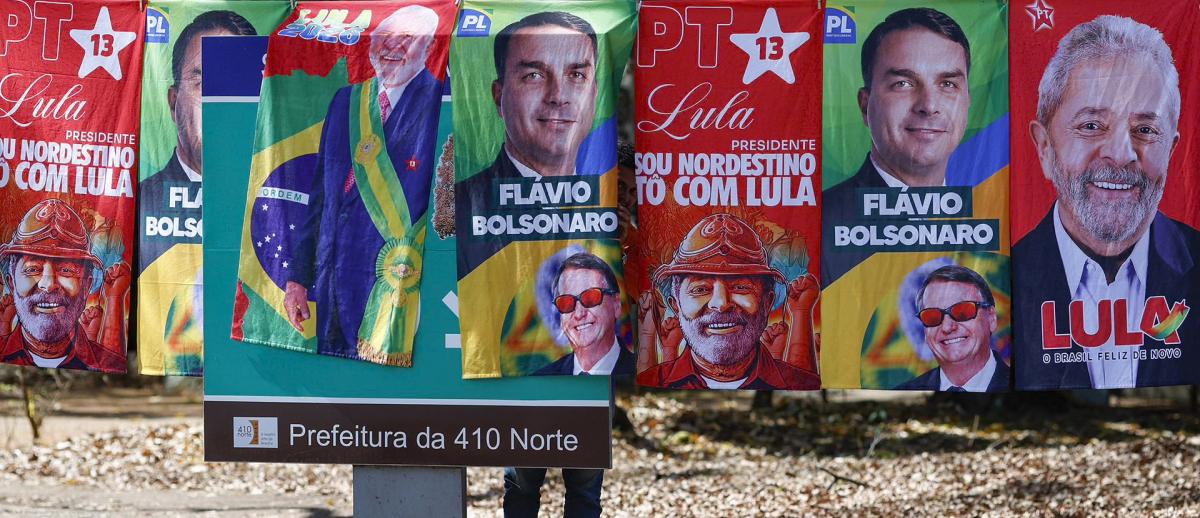
Towels and caps for sale in a residential area of Brasília depict Brazilian presidential candidates Luiz Inácio Lula da Silva and Flávio Bolsonaro, on September 11, 2026. Sergio Lima/AFP/Getty Images
Shock and Calls to Action in Brazil: The Turbulent Wake of the 2026 First-Round Election
Democracy in Brazil is now facing its greatest test since the restoration of constitutional order in the mid-1980s and the adoption of the new Constitution in 1988. The general election in Brazil includes candidacies for the presidency, Congress, governors, and state legislatures, and Brazilian society is divided between two staunchly opposing candidates and ideologies: President Lula, who is seeking reelection to serve his fourth, non-consecutive term on a platform of defending sovereignty, democracy, the state as a driver of social justice, and an active diplomatic policy that includes its participation in the BRICS; and, on the other hand, Flávio Bolsonaro, the eldest son of former President Bolsonaro, who was imprisoned in November, 2025.
Flávio Bolsonaro’s candidacy embodies extreme neoliberalism, characterized by the erosion of social welfare programs and subservience to U.S. interests—specifically Donald Trump’s agenda, the strategic alliance with Israel, and antagonism toward vital Chinese investment. This economic platform is paired with fierce individualism and a devotion—genuine or opportunistic—to neo-Pentecostal social conservatism. Beyond that lies a trail of scandals: ongoing corruption investigations, public statements advocating the handover of critical minerals to the U.S., and photographic evidence linking him to the centerpiece of a Brazilian equivalent to the Epstein case. Most alarming, however, are his acknowledged connections to hitmen and local paramilitary groups (known as milicianos).
The first round of elections concluded on Sunday, October 4th, with shocking results. Flávio Bolsonaro came out on top with 47.03 percent of the vote, while Lula came second with 45.16 percent. The election will now be decided in a run-off on October 25th. These results reflect not only domestic issues, but also the rise of the far right globally. After Trump, this rise became evident with the 2018 victory of Flávio’s father,
Jair Bolsonaro. According to allegations made by former CIA members, who are now under investigation by the Federal Police, this advance is also being fueled from abroad. This support includes vast sums of money and assistance from US and Israeli intelligence services, including behavioral research and sophisticated technical tools. These amount to forms of foreign interference like those seen in recent elections in Chile, Bolivia, Ecuador, Peru and Colombia. All of this means Lula faces a much better-organized opposition than in 2022, both at home and abroad, and therefore a more dangerous one.
The outcome of the election in Brazil will have reverberations throughout Latin America, particularly in South America, given Brazil’s demographic, economic and political weight. We need only recall that, following the dictatorship established in Brazil in 1964, a ‘domino effect’ began, leading to the establishment of authoritarian regimes (and torture schools) in Chile, Uruguay, Argentina, and Peru. Brazil today is surrounded by far-right governments, with the sole exception of Uruguay. If a far-right government subservient to US interests takes power in Brazil, the United States, via the ‘Donroe Doctrine’ (the Monroe Doctrine, with the Trump corollary), will have secured control of this region, which it regards as its ‘backyard’. Restoring sovereignty and democracy in South America would then take decades. A Brazilian political analyst has published an article that also serves as a wake-up call, pointing out that a far-right victory in the second round of the Brazilian elections could be the last opportunity for all Brazilians alive today to exercise their right to vote… It is no coincidence that President Lula has received warm declarations of support from various social and political sectors across Latin America. The importance of Brazil’s resistance to the far right and Washington's complete domination of the region is readily understood beyond its borders.
Two factors require analysis: the high abstention rate, at just over 20 percent of the electorate – that is, 33 million voters! – and the drop in the number of votes received by President Lula in Sunday’s ballot: 4 million fewer votes than in the 2022 election, while candidate Flávio Bolsonaro’s lead over President Lula was just two million votes.
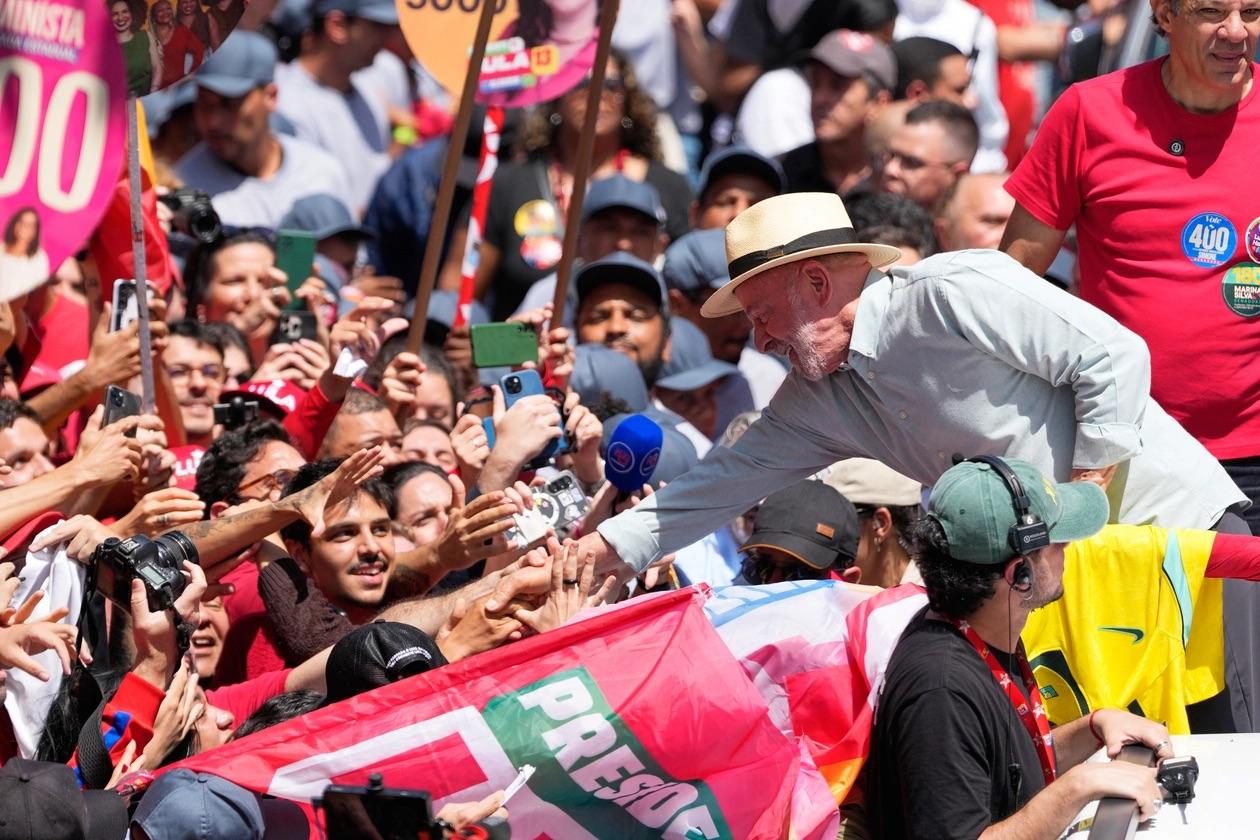
President Luiz Inacio Lula da Silva, who is running for reelection, greets supporters during a campaign rally a day ahead of the country's general election in Sao Paulo, Saturday, Oct. 3, 2026. (AP Photo/Andre Penner) | AP
These two factors highlight a sense of discontent among a section of the electorate over the high cost of living and the levels of violence (which the mainstream press takes it upon itself to highlight time and again). These are real problems in their day-to-day lives, particularly for the poorest workers, the unemployed, and those who earn a living through ride-hailing apps. Concerning violence, Flávio Bolsonaro’s most direct and even brutal message (the popular phrase being ‘a good criminal is a dead criminal’) may sound more convincing, even though during Jair Bolsonaro’s four years in office there were no improvements in this area; on the contrary, police lethality increased. As for the cost of living, the far-right blames President Lula, who has rightly emphasized the many public policies his government managed to implement, even while facing a hostile Congress. And without them, workers’ lives would indeed be much worse.
The fact is that, to overcome this sense of unease and disappointment with democracy, we need to offer solutions to this bitter daily reality. To do that, how can we avoid a sophisticated analysis that highlights the perverse nature of a system of exploitation, most visible in economic neoliberalism? None of this is easy to explain in an election campaign. It is even worse in campaigns where social media spreads fake and biased news, and the mainstream media plays into the hands of neoliberalism, glorifying fiscal austerity and wage cuts whilst condemning any investment in support of the most vulnerable and in high-quality public services (education, healthcare, transport).
It is therefore necessary, with a middle- and long-term perspective in mind, to define ongoing tasks in the area of political education – something which, regrettably, the left in these latitudes abandoned a long time ago. And to combine these tasks with an appropriate communications strategy that takes into account the country’s continental characteristics, as well as its regional, educational, cultural and generational diversity. This task may well require the organization of a ‘task force’ to begin studying the issue immediately, assessing the realistic possibilities for implementing measures and putting forward proposals.
In the short term, it is also necessary to confront the core message of certain neo-Pentecostal churches: the ‘Prosperity Theology’ churches – key players in the far-right campaign. In their messages, these churches distort the interpretation of everyday difficulties. They advocate seeking individualistic solutions and personal fulfillment (in material terms, of course), while neglecting to address society or political practices aimed at the common good. Their message spreads rapidly among a population that lacks access to quality education and cannot develop critical thinking skills. Yet it is misleading to teach that success (of the very few) is the result of individual effort, just as failure (of the many) is, a situation which is leading to an exponential rise in mental health problems and even suicide, while at the same time encouraging people to turn their backs on politics, which is portrayed as essentially ‘corrupt’ and evil. What is presented as ‘failure’ is, in fact, the result of an oppressive system with both domestic and international manifestations, and of a lack of support and political will to implement measures that would necessarily run counter to that system.
But these issues require a deeper, broader analysis. Brazil now faces a challenge: a three-week campaign to try to defeat the far right, which has already secured control of Congress and most of the states in the federation in the first round. And because it holds this control, it will do everything in its power not only to prevent Lula’s victory in the second round, but – should it be defeated – to use this majority to leave the President with little room to pass measures opposed to its agenda. Even so, the challenge now is to fight to retain the presidency without ignoring the difficulties ahead.
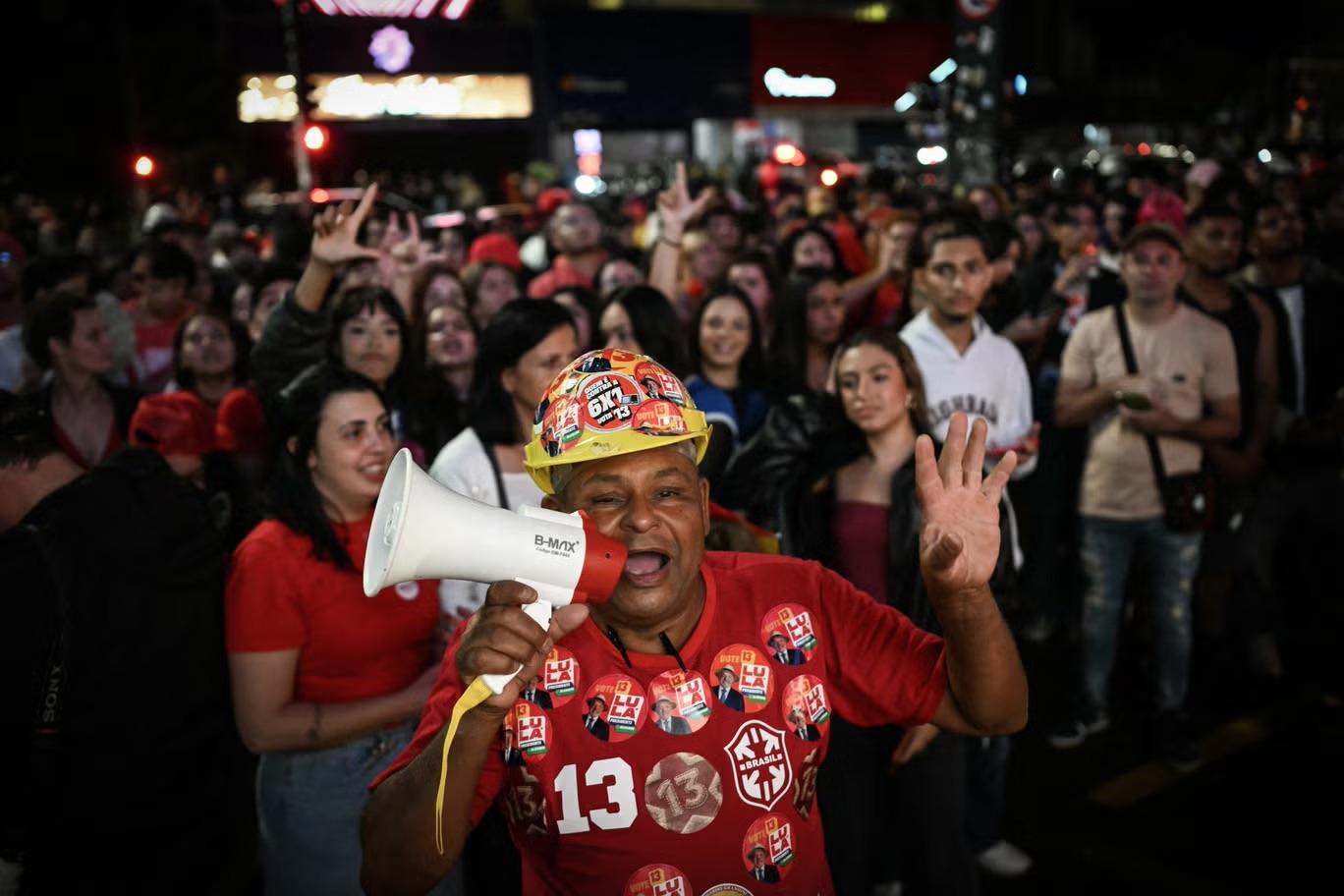
Supporters of Brazil's president Luiz Inacio Lula da Silva react after the first results of the presidential election in Sao Paulo, Brazil, on 4 October 2026 (AFP/Getty)
So, we need to roll up our sleeves, take to the streets, and talk to voters who abstained from voting and to those dissatisfied with what democracy has offered them. We need to engage intelligently on social media and always, always appeal to emotion, as many experts believe this is what determines a voter’s choice. To this end, we must speak with the utmost clarity about what a victory for Flávio Bolsonaro would mean! This issue requires much explanation to the public, and the first-round campaign did not address it adequately. The majority of the Brazilian population has no realistic idea of the suffering that awaits them if the far right wins the election! Because the vote for Flávio Bolsonaro was, to a large extent, not an ideological vote, but a vote driven by discontent and protest, often fueled by falsehoods spread via social media platforms controlled by big tech, which found fertile ground in a reality that falls short of the legitimate expectations of many ordinary citizens.
Over these three weeks, we must make voters – particularly youth voters– aware of the price Brazil paid for 21 years of dictatorship. The struggle to restore democracy involved personal sacrifice, torture, bloodshed, and exile for thousands of Brazilians. Is the democracy we have not the one we would wish for? In that case, we must remember President Lula’s message in his final campaign interview: democracy is something we all build together; we must take part in political life – young people, those not so young, and the elderly! Only then will we also have the right to criticize!