Race (In)Visible: A Forensic Reading of Bodies, Archives, and City Landscape in São Paulo’s Prison Massacre
archive

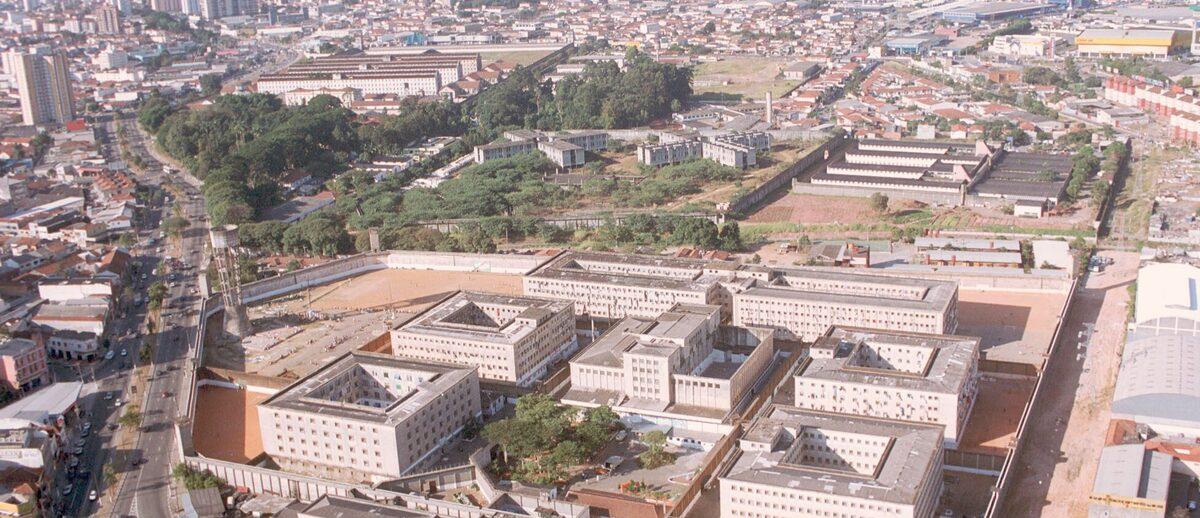
Aerial view of the Carandiru Penitentiary Complex, São Paulo, Brazil, c. 2000. Photograph by Sérgio Castro / O Estado de S. Paulo.
Race (In)Visible: A Forensic Reading of Bodies, Archives, and City Landscape in São Paulo’s Prison Massacre
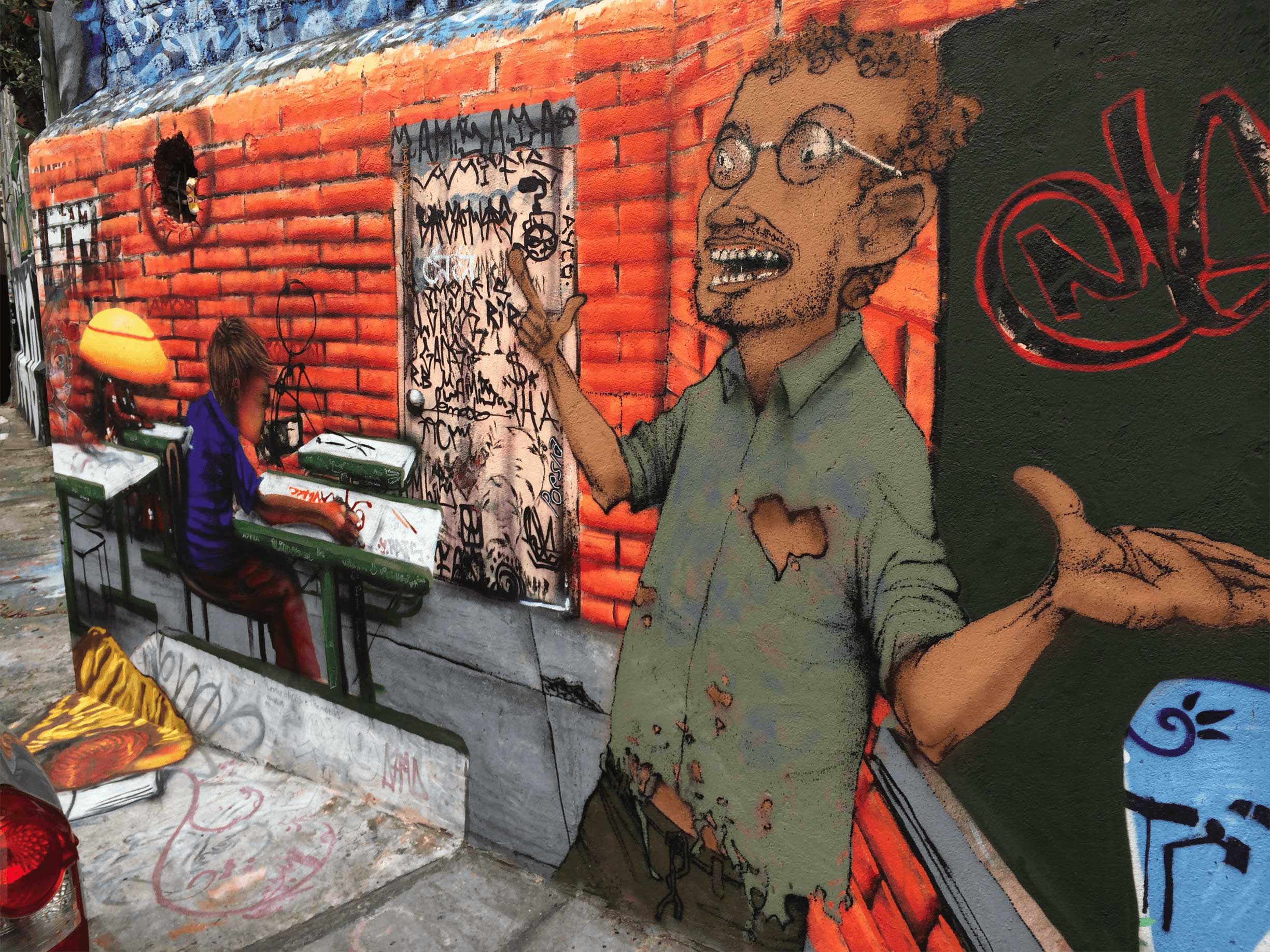
On October 2, 1992, military police stormed wing nine of the House of Detention/Carandiru Penitentiary in São Paulo, Brazil. The operation followed an internal conflict among prisoners and was justified as a necessity to restore order. The official record, released three days later, stated that 111 incarcerated men were killed. Since the first hours after the massacre, however, incarcerated people and later survivors have contested this number, asserting that the true death toll was significantly higher.
Carandiru then became the most iconic symbol of police violence in Brazil, a country that had just emerged from a twenty-year military dictatorship (1964–1985) and just adopted a new Constitution (1988). The massacre reignited long-standing debates about the deactivation of that massive penitentiary complex (Tavolari and Machado 2025), and in 2002, the House of Detention was finally deactivated, imploded, and replaced with a park built over its ruins. This transformation - simultaneously material, political, and symbolic - created a very fertile ground for archaeologists to think about the recent past, the transformation of the city’s landscape, and the pursuit of justice.
Closely working, as an archeologist, with survivors and social movements I have been confronted with the methodological and ethical foundations of doing archive work. As one woman shouted through a megaphone during a protest marking the anniversary of the 1992 massacre: “We don’t want to be part of another thesis. We want to live and we want justice”. Over the years, I heard several times another important statement: “the state lied about the number of people killed.”
Taking this statement seriously required reframing my original research question: rather than asking how the Carandiru Massacre happened, I began asking whether the official number of victims is accurate, and how material and archival evidence may offuscate truth. The remaining materiality of the prison and of its daily life - including episodes of violence - became the main source of information for this research, working as an additional layer of “evidence” to tell stories, to build understanding, and to strengthen the survivors’ testimonials (as argued by De Leon et al. 2015)
One striking example is a photograph published three days after the massacre, showing a handwritten sign in the prison window that reads that 280 people died in the massacre. Even before public discourse solidified around the number 111, incarcerated men were publicly asserting that the official count was inaccurate.
![Copy of the newspaper Folha da Tarde, October 5, 1992 edition. Source: Commission Teotônio Vilela Collection, São Paulo State Public Archive (CTV-APESP).]](/sites/default/files/styles/container_image/public/images/Fig%201%20Folha%20da%20Tarde%20280%20mortos.png?itok=4amv9XAO)
Copy of the newspaper Folha da Tarde, October 5, 1992 edition. Source: Commission Teotônio Vilela Collection, São Paulo State Public Archive (CTV-APESP).]
Carandiru and the Urban Military Landscape of São Paulo
The Carandiru Penitentiary Complex was not an isolated space - it was embedded in a long-standing spatial logic of control. Historical maps of São Paulo show a “military corridor” stretching from the city center to the north, incorporating barracks, penitentiaries, and early aviation infrastructure. The first structure in the area, built around the decade of 1850, was a prison that held, among others, formerly enslaved people during the late 19th and early century (Calazans in press).
![Military corridor, São Paulo c.1924 (APESP) and 2024 (Google Earth)]](/sites/default/files/styles/container_image/public/images/crowded%20chairs%20are%20at%20UERJ%20%28University%20of%20The%20State%20of%20Rio%20de%20Janeiro%29.png?itok=QNwei6ME)
Military corridor, São Paulo c.1924 (APESP) and 2024 (Google Earth)]
By the 1970s - peak years of Brazil’s military dictatorship - this corridor reached its highest density of carceral and military institutions. In the same decades, surrounding neighborhoods saw the growth of informal settlements, later formalized as favelas. The juxtaposition of favelas and penitentiaries mapped and reproduced a social order in which poverty, proximity to police forces, and incarceration formed a continuous chain.
As argued by Raquel Rolnik (1989), historically, Black territories in São Paulo were never exclusively Black in demographic terms; rather, they concentrated the city’s poor populations within spaces produced as Black through racialized processes of exclusion and control. In this sense, the continuity between slavery, the formation of Black territories, and their persistent exposure to police surveillance reveals how racial criteria operate as spatialized regimes of governance linking poverty, policing, and incarceration.
Even after democratization in 1985, the corridor persisted. While Carandiru’s House of Detention was imploded in 2002–2003 in a media spectacle framed as symbolic closure, most institutions in the corridor remain active, including ROTA – a highly lethal police force established in 1970 in the former Luz Barracks. Today, two major facilities in the complex incarcerate women, signaling what I identify as the feminization of Carandiru rather than its abolition.
Although no excavation has yet been permitted, the site continues to produce material evidence - through architecture, records, testimonies, personal belongings, and urban transformation – of human rights violations. In the case presented, an archaeological approach means treating archives not as neutral repositories, but as material artifacts shaped by power, violence, and omission.
Reading Necroscopic Reports as Material Culture
When the access to the physical bodies of the victims is no longer possible; what remains are necroscopic reports. I located and analyzed 96 of the 111 reports that the state acknowledges exist. Their structure follows a standard format: Civil identification information; Descriptive medical examination; and An anatomical diagram marking injuries.However, the apparent bureaucratic ordering collapses in an arbitrarian fashion. For instance, many (81) reports initially list the body as “unknown.” How would a body, held captive by the state in a prison - a controlled and monitored environment – be unknown? Later the same form lists the body as “identified,” yet the method of identification is never recorded.
Further irregularities include missing forensic photographs, reports with incomplete or contradictory injury descriptions, technical disclaimers stating insufficient working conditions and mismatched racial ascriptions between report sections. These inconsistencies point to an overburdened forensic system operating under political pressure and limited oversight. In this context, it is also important to note that such precarity ultimately benefited the State and its agents to the detriment of the victims; and to question the convenience of this precarity for a State implicated in human rights violations. These do not appear to be innocent errors, but rather mechanisms of revictimization concealed within the banality of clerical and medico-legal procedures.
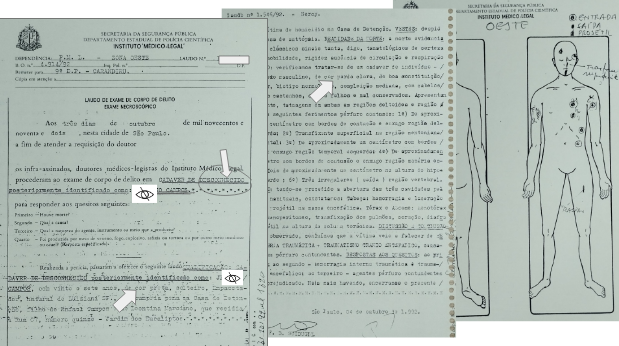
Sample of a necroscopic report of a victim of the massacre officially recognized as such. Source: CTV-APESP. Personal data has been hidden for privacy reasons.
Classificatory practice is part of a broader state dispositif, through which discretionary decisions regarding the inscription, omission, and correction of social markers as race and gender are routinely exercised. These administrative acts produce official identities for both the living and the dead. For the deceased in particular, they mark a crucial moment in which a citizen is circumscribed within the bureaucratic regime of death. In cases of violent death, such data constitute critical information for judicial processes. When intentional or unintentional errors occur, they jeopardize the very possibility of justice.
Among the most revealing inconsistencies in the Carandiru case are those concerning racial classification. In Brazil, race is routinely recorded in both police and death records, yet classification is highly subjective and often varies according to the observer. After building a comparative table from the 96 available reports, we can see the inconsistency as a pattern.
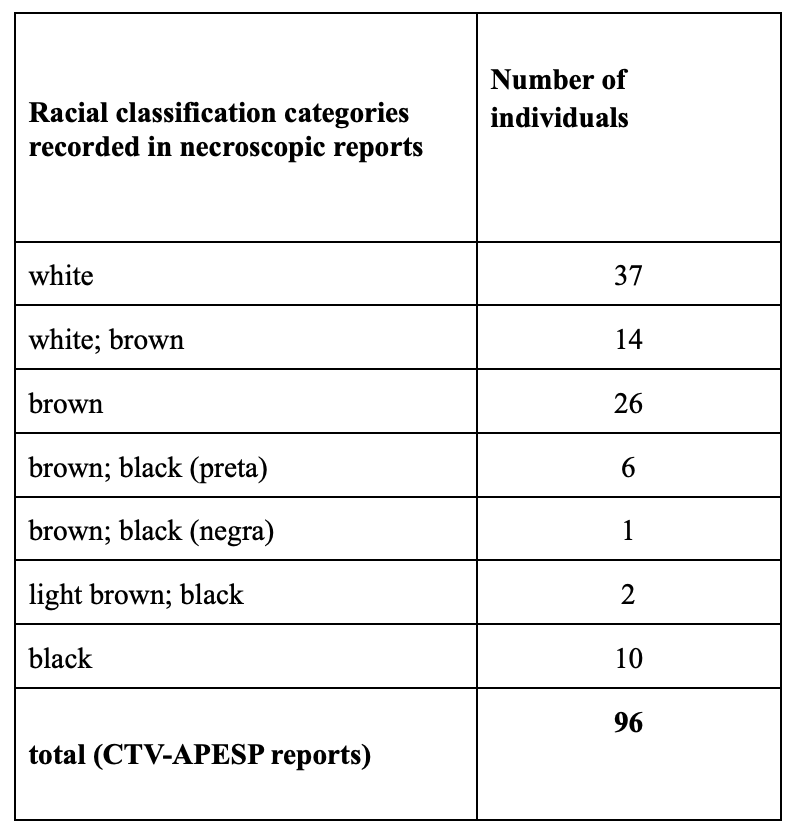
Racial classification inconsistencies. Frequency of racial ascription (hetero-identification) based on 96 autopsy reports of fatal victims of the massacre at the São Paulo House of Detention.
Some individuals were recorded as white in the identification section but brown (pardo) or even Black during the physical examination. In other reports, the classification shifts in the opposite direction. This is not a trivial clerical issue: mismatched racial data raises the question of whether the documented identity corresponds to the examined body. In other words, race - often treated as secondary - may function as a forensic tool for identifying bureaucratic manipulation of data.
Toward a Theory of Disappearance Without a Missing Body
Carandiru introduces a different scenario from disappearance frameworks in which bodies are hidden, destroyed, or intentionally mislabeled: here, individuals may have been disappeared within the forensic process itself, as in the case of the Perus mass grave1 (Hattori et al. 2016), yet without leaving an identifiable missing person to be searched for. This phenomenon - where disappearance is disguised as documentation - has been theorized as the “disappearance of the disappearance” (Gonzalez-Ruibal 2008; Cyr 2013). In such cases, the archive functions as both evidence and concealment.
This research is conducted in collaboration with survivors of the massacre and broader civil society organizations advocating for Memory, Truth and Justice. Their reflections shape the investigative priorities and ethical responsibilities of the work. Rather than treating their statements as supplementary testimony, this project recognizes them as epistemic authorities and active producers of knowledge. Their insistence that “the numbers are wrong” is an evidentiary hypothesis guiding the research design.
Even when state archives cannot prove them right, the concealment, disorganization, restricted access to public information, missing documents, and mismatched personal data of the victims reveal how public institutions operate in conjunction with the State’s technologies of disappearance. In this sense, the official figure of 111 deaths or the claimed number of 280—and, at times, even higher estimates—cannot be verified or falsified, but instead serve as an index that exposes the limits of official accounting and challenges the State’s capacity to monopolize truth about its lethal violence.
The findings presented here are partial and ongoing. While the forensic inconsistencies alone cannot yet confirm the existence of missing victims, they reveal systemic procedural failures and raise credible grounds to investigate whether the official record conceals additional deaths. More broadly, the Carandiru Massacre must be understood not as an isolated atrocity, but as part of a longer historical continuum in which race, urban planning, policing, and incarceration intersect to produce death and disappearance as state practices.
Note from the Author
"I thank the Educativo Memórias Carandiru: Helen Baum, Maurício Monteiro, and Nádia Lima. Maurício Monteiro, a survivor of the Carandiru Massacre, has also been a central collaborator in this research, and I am deeply grateful for his generosity and trust, as well as to his family. I also wish to acknowledge other survivors of the massacre who contributed directly or indirectly to this work, including André du Rap, Luiz Paulino, and Sidney Sales.
I thank the Research Group on Law and State Violence at FGV Direito SP, especially Maíra Machado, Carolina Cutrupi, and Bianca Tavolari. I am grateful to my colleagues at the Center for Forensic Anthropology and Archaeology at the Federal University of São Paulo and at the Undocumented Migration Project Lab at UCLA. I also thank Professor Veronica Wesolowski and colleagues at the Museum of Archaeology and Ethnology at the University of São Paulo.
Finally, I acknowledge the collectives confronting state violence and struggling for a dignified life, especially the movements of mothers and family members of victims of state violence and the collectives active in Cracolândia.
This research is supported by the Fulbright Program."
The Perus clandestine mass grave refers to an illegal burial site uncovered in 1990 at the Dom Bosco Cemetery, in the district of Perus, São Paulo. The grave contained the remains of more than one thousand individuals buried anonymously by state authorities in the 1970s. To this day, processes of identification remain ongoing, underscoring how disappearance operates not as a lack of evidence, but as a regime of concealment sustained by bureaucratic practices, delayed recognition, and contested truth.
Calazans, Marília Oliveira. In press. “Carandiru feminino: mulheres e marcas do gênero em uma paisagem carcerária de São Paulo (1851–2024).”
In Paisagens do autoritarismo, edited by Aline Carvalho, Andrés Zarankin, and Fernanda Lima. Campinas: Editora da Unicamp.
Cyr, Rachel E. 2013. “Testifying absence in the era of forensic testimony.” International Journal of Politics, Culture, and Society 26 (1): 93–106.
De León, Jason, Cameron Gokee, and Ashley Schubert. 2015. “By the Time I Get to Arizona: Citizenship, Materiality, and Contested Identities along the U.S.–Mexico Border.” Anthropological Quarterly 88: 487–520.
González-Ruibal, Alfredo. 2008. “Time to Destroy: An Archaeology of Supermodernity.” Current Anthropology 49 (2): 247–279.
Hattori, Márcia Lika, et al. 2016. “O caminho burocrático da morte e a máquina de fazer desaparecer: propostas de análise da documentação do Instituto Médico Legal–SP para antropologia forense.” Revista do Arquivo 2
Rolnik, Raquel. 1989. “Territórios negros nas cidades brasileiras: Etnicidade e cidade em São Paulo e Rio de Janeiro”. Revista de Estudos Afro-Asiáticos, 17, 1–17.
Tavolari, Bianca, and Maíra Machado. 2025. “Disputar a cidade e a prisão: As propostas de desativação da Casa de Detenção antes do massacre do Carandiru.” Novos Estudos CEBRAP 44 (1). https://doi.org/10.25091/S01013300202500010004