Whiteness and Plantationcracy in Brazil: Universities, Prisons, and the Imperative of Epistemic Abolitionism
archive

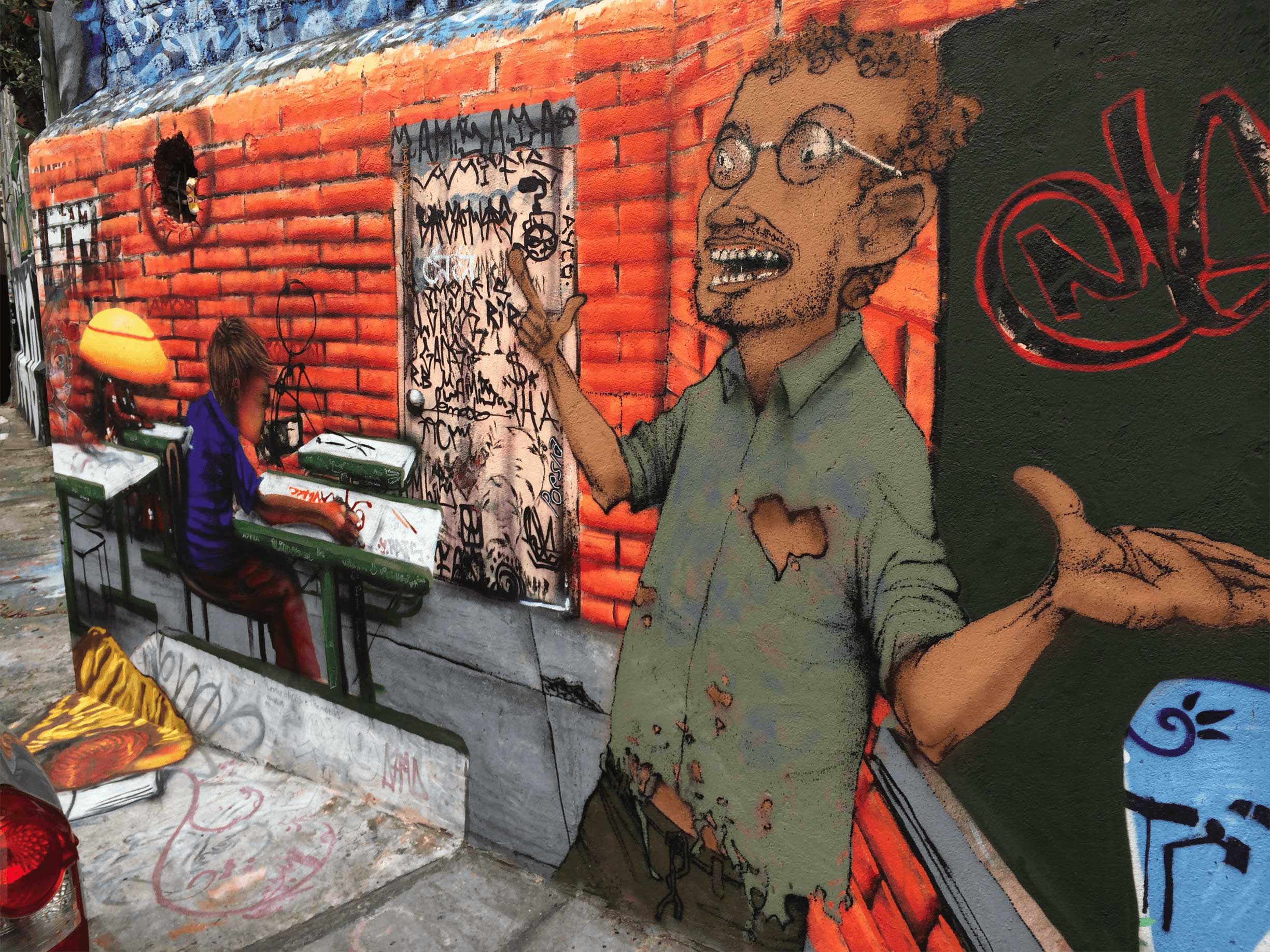

Left) Crowded chairs are at UERJ (University of The State of Rio de Janeiro)
Right) Before unpacking, the desks are scattered and not yet assigned a purpose. Once they are arranged, their role in straightening bodies and souls in the epistemic plantation becomes neat.
Whiteness and Plantationcracy in Brazil: Universities, Prisons, and the Imperative of Epistemic Abolitionism
On October 28, 2025, provincial police invaded the favelas of Alemão and Penha in Rio de Janeiro, killing at least 130 people, mostly Black men. The carnage attracted international scrutiny, but domestically, the governor declared the operation a “success”, echoing popular support for security as policing. Leading newspapers published the story on their front pages, showing a striking photograph of dozens of naked corpses arranged side by side. This image appeared after a bloody night when local residents and families searched for victims and carried them to the nearest public square. A few days later, after the voyeuristic and morbid consumption of the men's flesh, the newspaper reassured readers that the city had returned to normal. Many liberal observers questioned why police opened fire at night in a densely populated area and executed suspects allegedly involved in drug trafficking without due process. They argued that even if the death penalty were legally sanctioned, a conviction process would be required before any execution. More progressive researchers said such circumstances should be inconceivable in any democratic nation. This context prompted another critical liberal question: why were these men not arrested instead?
White liberals debated whether such violence was legitimate, rather than questioning its underlying premises. Some commentators said that by equating drug trafficking with terrorism, the provincial government enabled indiscriminate targeting based on potential threats to society. Others argued that by aligning with supremacist ideologies linked to the United States, the right-wing local government sought support against the federal government ahead of the 2026 presidential election. Many other hypotheses have been proposed, but they share a common feature: the normalization of black bodies as expendable resources for building a non-conflictive republican order and defending what is seen as the rule of law. For white liberals, the main concern was the inadequate police approach, captured in the newspaper’s front-page photo, not the State's prerogative to kill.
The number of Black men incarcerated in Brazil's prison system is nearly equal to the number of students enrolled in public universities. However, most university students are not Black. Over the past two decades, in response to demands from Black movements for social justice, affirmative action policies have increased Black students' access to and retention in public higher education, which is tuition-free in Brazil. These measures have changed classroom demographics and begun to influence faculty composition, leading to a modest increase in Black educators and prompting debates over curricula (Borges & Bernardino-Costa, 2022).
White supremacists, implicated in producing corpses from Black bodies—rendered as mere flesh, as described by Hortense Spillers (1987)—including events like the 28 October massacre, also target affirmative action in Brazilian public universities as terrorism that must be suppressed. Black Brazilians, whether in favelas or higher education, are constructed as threats to the abovementioned republican order. Persistent efforts to frame so-called “identitarian” agendas as assaults on the republic are used to justify deploying lethal force, both epistemic and physical, to protect the privileged citizenry of white people.
Typically, the white saviour invokes republican principles to criticize policies perceived as discriminatory. Affirmative action policies are equated with acts of terrorism, and quotas are depicted as the primary weapon of this perceived threat. Aligned with a global supremacist agenda, they fear that mandatory inclusion and equity policies, particularly those addressing race, gender, and sexuality, like recent affirmative action initiatives for trans* people in many Brazilian universities (Iazzetti, 2024; dos Santos, 2023), threaten what they define as republican human rights. This cognitive operation reveals an equation of humanity with white males, closely paralleling Sylvia Wynter’s (2006) argument regarding the conflation of American white males with the concept of humanity.
Police killings targeting black males and the erasure of black students and faculty from the university are white settler practices that walk in tandem in Brazil.
It is no surprise, then, that on 10 December 2025, the provincial chamber of deputies of Santa Catarina, in southern Brazil, approved a bill prohibiting quotas and other race-oriented affirmative action in higher education for both student admissions and faculty hiring. Although this measure is allowed under Brazil's federal constitution, which grants provinces some autonomy, it directly challenges and undermines federal affirmative action policies and constitutional rights. Such quotas have been in place nationally since the early 2000s in response to the Black movement's call for social justice. Santa Catarina is known for the State-supported European colonization project in the late 19th century, which aimed to exterminate the local indigenous population and promote the region's whitening. Most of the local population votes for right-wing and supremacist politicians who support separatist and xenophobic policies toward northern Brazil and its predominantly Black population.
The supposed benevolence of these actions—carnages to protect propertied citizens and legislative amendments against affirmative action—led by white people is presented as unequivocal. Proponents of these reactionary policies claim to promote national unity while criticizing Black movements as divisive and inherently racist. Denying antiblackness serves to reinforce Rio de Janeiro, São Paulo, and all of Brazil as whitopia (Alves & Paterniani, 2024; Alves, 2018; Costa Vargas, 2004), the optimum world of white supremacy, through a redemptive and uncritical narrative of settler colonial imperial invasion and history.
These narratives characterize the Black young men killed at point-blank range in Rio de Janeiro not as humans, but as bandits or criminals, and thus less than human. Similarly, these perspectives hold that students and faculty should be selected for universities solely based on admission exam performance, explicitly excluding race, gender, or sexuality. The production of less-than-humans is the production of the settler ontoepistemology. In the Cartesian quadrant, whitopia happens in the negative, in the subtraction, through the production of the less-than-humans.
Prisons and universities are often seen as institutions that should operate uniformly, regardless of context or individual differences. When the majority in universities and the Santa Catarina parliament are white, and the incarcerated population is mostly black, these narratives attribute such disparities to merit and moral failing. This perspective implies that prisons are standardized for black people, while universities are standardized for whites only. It overlooks the historical privileges established by scientific racism, which legitimized the usurpation of black lands and bodies for imperial plantatiocratic expansion. Global white supremacy is sustained by enduring plantation systems that t(h)reat Black lives as expendable resources. White anxiety over perceived loss of dominance in settler societies drives reactionary responses that reinforce plantation structures like prisons and universities, especially when quilombos emerge and challenge established boundaries and social hierarchies (Borges, 2021).
Within the context of Brazil's supposed racial democracy and the perceived threats of Blackness, the transparency of white Brazilians is often seen as a stabilizing force in a "miscigenated harmonious republic”. White's recognized expertise is often cited as a basis for steadiness in academic affairs, historically reinforcing a developmentalist agenda that keeps the country within a globally structured epistemic plantation system. In this framework, Brazil's intellectual marginalization is masked by its role as an extractivist zone. There is also a persistent belief that meritorious poor white individuals will not be left unsupported or subordinated by descendants of the enslaved, reflecting deep anxiety among white settlers in societies with apartheid-like structures such as Brazil.
The elimination of affirmative action in Santa Catarina parallels the Supreme Court of the United States' July 2023 decision prohibiting race-based affirmative action in universities and faculties. Despite different patterns of race relations in Brazil and the United States, a key commonality remains: the centrality of the analytics of raciality, and the recognition of the racial event not as a discrete moment in human history, but as a singularity, persistently unacknowledged by white supremacy as articulated by Denise Ferreira da Silva (2007) and Christina Sharpe (2016).
When Academic Labour Meets Police Labour
Both physical violence and ideological backlash have targeted young Black men in the United States and Brazil since colonization began. In Brazil, a nation built on the exploitation of enslaved Black people, as Abdias Nascimento (1978) observed, white intellectuals have feared that race-based affirmative actions would threaten local racial harmony. A significant academic backlash against affirmative action in universities occurred in 2006, when prominent white progressive intellectuals, fearing the divisive effect of an imported antiracist agenda, signed a Manifesto contra as Cotas.
Drawing on Sylvia Wynter’s formulations (2006), we contend that the actions of the White State regarding race, shown by police violence against young Black males, parallel the White University’s approach to race. The University and its major progressive white intellectuals often dismiss race as a central analytical category or pacify it through ethnohistory, reinforcing narratives of harmonious race relations.
These periodic backlashes should be seen as manifestations of plantation logics (Borges, 2021) and the whiteness of the State (Paterniani, 2016), which continue to shape contemporary society. The plantatiocracy is reflected in the rigid infrastructures of university campuses and the linear progression of academic careers, as well as in the linearity of inmate cell bars and the confined territories and times of jail (McKittrick 2011). These structures perpetuate a temporality of causality and sequence (Ferreira da Silva, 2007) in which the t(h)reat of Black bodies as flesh or corpses is recurrent, from the favelas to academic institutions.
Only by acknowledging it as such can one step outside that temporality and transcend its confinements. Living on the edge threatens only the continuation of whitopia. In Brazilian peripheries, a common gadget is the linha com cerol, a transparent latex line coated with crushed glass, used for kite flying. Young Black men use it to compete for each other's kites, sharpening the line for this purpose. Distant white observers often miss the playful risk involved, instead perceiving only the threat to their privileges and justifying the erasure of Black youth to protect their own throats from being cut.
Alves, J. A.; Paterniani, S. Z. 2024. In the Wake of Bulldozers: Speculations on Space, Race, and Insurgent Life in Two Latin American Cities. The Funambulist, v. 56, p. 60-67.
Alves, J. 2018. The Anti-Black City: Police Terror and Black Urban Life in Brazil. Minneapolis, MN: University of Minnesota Press.
Borges, A. 2021. Very Rural Background: on how a land-composition challenges Higher Education in South Africa and Zimbabwe. Revista de Antropologia, v. 63, http://dx.doi.org/10.11606/2179-0892.ra.2020.178183
Borges, A., & Bernardino-Costa, J. (2022). Dessenhorizar a academia: ações afirmativas na pós-graduação. Mana, 28(3), e2830401.
Costa Vargas, J. H. 2004. “Hyperconsciousness of Race and Its Negation: The Dialectic of White Supremacy in Brazil.” Identities 11 (4): 443–70. doi:10.1080/10702890490883803.
dos Santos, J. B. (2023). Expressões da ofensiva antigênero no Brasil: da transnacionalização às estruturas do estado. PhD Dissertation. Federal University of Minas Gerais.
Ferreira da Silva, D. 2007. Toward a Global Idea of Race. University of Minnesota Press.
Iazzetti, B. 2024. POSSIBLE TRANS* FUTURES?: Intersectionalities and ambivalences in the access and permanence of trans people* in Brazilian public higher education. Sex., Salud Soc. 40. https://doi.org/10.1590/1984-6487.sess.2024.40.e22207.a.p
McKittrick, K. 2011. On plantations, prisons, and a black sense of place. Social & Cultural Geography, 12(8), 947–963. https://doi.org/10.1080/14649365.2011.624280
Nascimento, A. 1978. O genocídio do negro brasileiro. São Paulo: Paz e Terra.
Paterniani, S. 2016. Da branquidade do Estado na ocupação da cidade. Revista Brasileira de Ciências Sociais, 31 (91). https://doi.org/10.17666/319109/2016
Sharpe, C. 2016. In the Wake: On Blackness and Being. Duke University Press.
Spillers, H. 1987. "Mama's Baby, Papa's Maybe: An American Grammar Book." Diacritics 17.2 : 65-81.
Wynter, S. 2006. “On How We Mistook The Map for the Territory, and Re-Imprisoned Ourselves in Our Unbearable Wrongness of Being, of Désêtre - Black Studies Toward the Human Project”. In: L. Gordon & J. Gordon (orgs.), Not Only the Master’s Tools - African-American Studies in Theory and Practice Boulder/Londres: Paradigm Publishers.